Three particles $A,$ $B$ and $C$ are situated at the vertices of an equilateral $ΔABC$ with sides each of length $l.$ Particle $A$ moves towards particle $B$ with a speed of $s.$ Simultaneously, particle $B$ moves with the same speed towards particle $C$ and $C$ moves towards particle $A.$ Tracing out a pursuit curve, they meet each other.
What is the distance covered by particle $A$ when it revolves around by $2π$ radians?
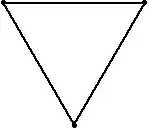
I could find out the total time taken by the particle $A$ to collide with $B$ (which is $\frac{2l}{3s}$) and total distance $l$ covered by $A$ but I could not figure out the distance traced to revolove 360°.


