In case of split-complex numbers it is easier to get the reverse triangle inequality than the usual one!
Let us restrict our attention to split-complex numbers $z = a+bj$ with $a^2 \ge b^2$. For them we can define the modulus to be $|z| = \sqrt{a^2-b^2} \in \mathbb{R}^+$. The set of such split-complex numbers form the following blue region on the split-complex plane:
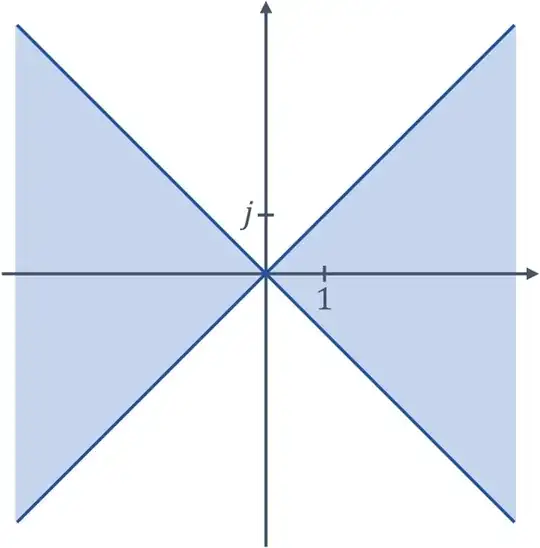
Note that this region is non-convex. So even if both $z_1$ and $z_2$ belong to the blue region, their sum may fall out of this region, and then the modulus $|z_1+z_2|$ will be ill-defined. To fix this issue, we further restrict our attention to one of its convex subregions: either with $a \le 0$ or $a \ge 0$.
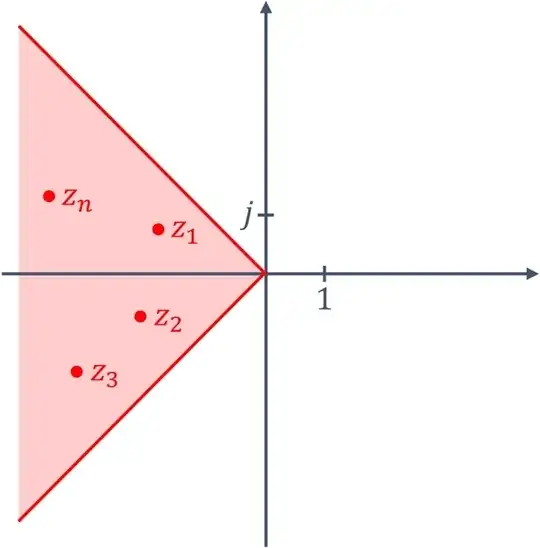
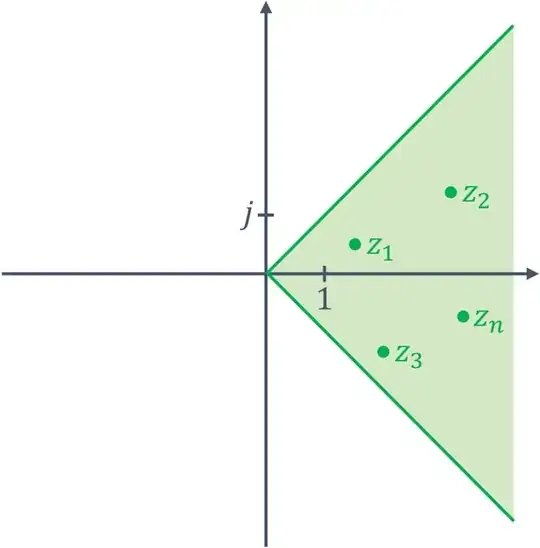
Working within one of these subregions (red or green), one can see that for any $z_1 = a_1 + b_1 j$ and $z_2 = a_2 + b_2 j$ the following inequalities hold:
$$
a_1 a_2 \ge b_1 b_2, \quad \quad (a_1+a_2)^2 \ge (b_1+b_2)^2. \tag{*}
$$
Now we start with the obviously true inequality and go step by step:
$$
0 \le (a_1b_2 - a_2 b_1)^2,
$$
$$
-(a_1b_2)^2-(a_2b_1)^2 \le -2a_1a_2b_1b_2,
$$
$$
\color{gray}{ (a_1a_2)^2+(b_1b_2)^2}-(a_1b_2)^2-(a_2b_1)^2 \le \color{gray}{ (a_1a_2)^2+(b_1b_2)^2}-2a_1a_2b_1b_2,
$$
$$
(a_1^2-b_1^2)(a_2^2-b_2^2) \le (a_1a_2-b_1b_2)^2
$$
$$
\Downarrow \text{ using (*)}
$$
$$
\sqrt{(a_1^2-b_1^2)(a_2^2-b_2^2)} \le (a_1a_2-b_1b_2),
$$
$$
2\sqrt{(a_1^2-b_1^2)(a_2^2-b_2^2)} \le 2 a_1a_2-2b_1b_2,
$$
$$
\color{gray}{a_1^2-b_1^2+a_2^2-b_2^2}+ 2\sqrt{(a_1^2-b_1^2)(a_2^2-b_2^2)} \le \color{gray}{a_1^2-b_1^2+a_2^2-b_2^2} + 2 a_1a_2-2b_1b_2,
$$
$$
\left(\sqrt{a_1^2-b_1^2}+\sqrt{a_2^2-b_2^2}\right)^2 \le (a_1+a_2)^2-(b_1+b_2)^2
$$
$$
\Downarrow \text{ using (*)}
$$
$$
\sqrt{a_1^2-b_1^2}+\sqrt{a_2^2-b_2^2} \le \sqrt{(a_1+a_2)^2-(b_1+b_2)^2}.
$$
So we get the reverse triangle inequality:
$$
|z_1|+|z_2| \le |z_1+z_2|.
$$
It is easy to show by induction that if all $\{z_n\}$ belong to the same convex region (red or green), then the reverse triangle inequality still holds:
$$
\sum|z_n| \le \left| \sum z_n \right|.
$$
In contrast to that, the usual triangle inequality $|z_1| + |z_2| > |z_1 + z_2|$ may hold only if $z_1$ and $z_2$ belong to different regions (e.g., $z_1 \in$ red, $z_2 \in$ green). Note that such an arrangement cannot be continued by induction, so it seems that no simple conditions for $\sum|z_n| > \left| \sum z_n \right|$ can be found. I believe that (in case of split-complex numbers with $|z| \in \mathbb{R}^+$) it is more natural to work with the reverse triangle inequality than with the usual one.


