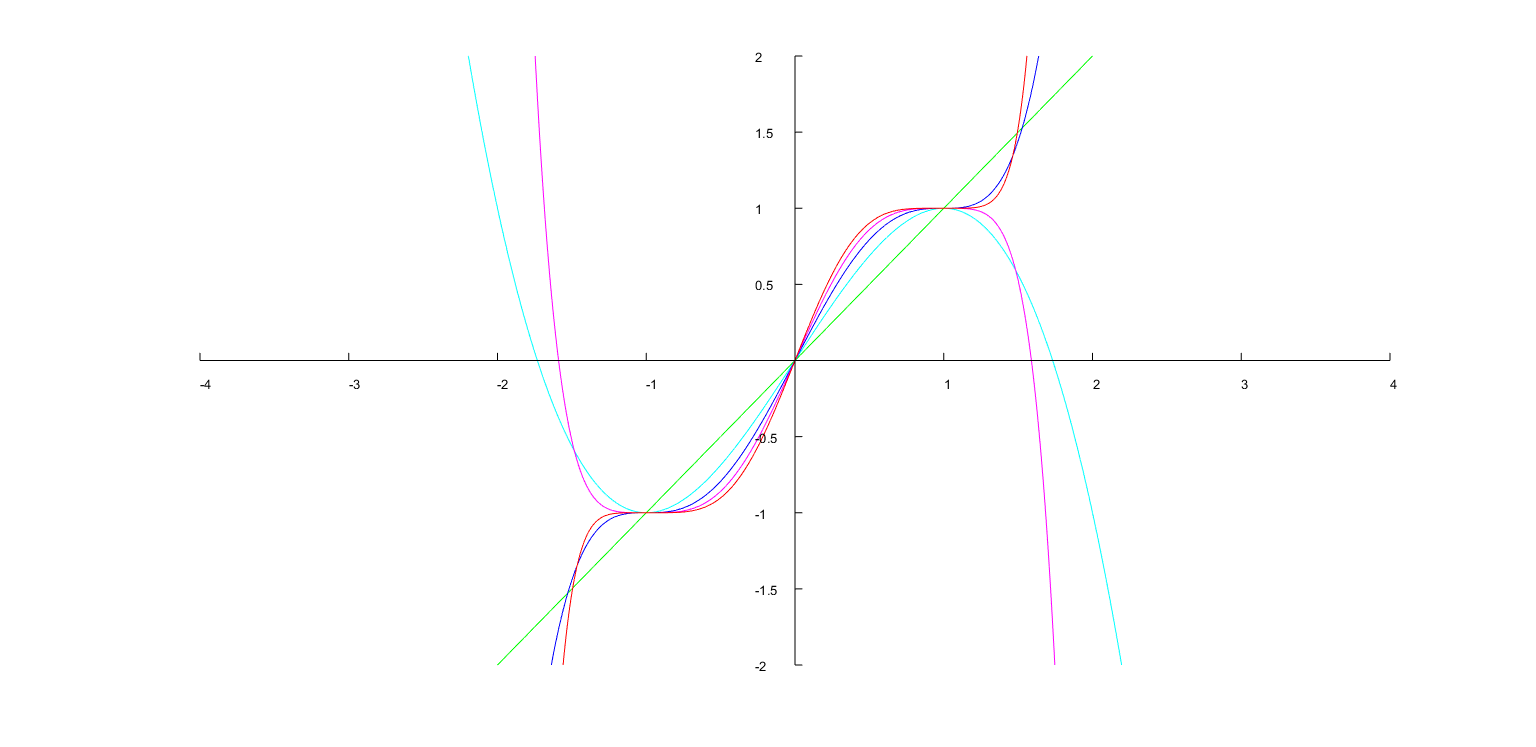
The Smoothstep sigmoid-like function is defined as the polynomial
$$ \begin{align} \operatorname{S}_N(x) &= x^{N+1} \sum_{n=0}^{N} \binom{N+n}{n} \binom{2N+1}{N-n} (-x)^{n} \qquad N \in \mathbb{Z} \ge 0 \\ &= \sum_{n=0}^{N} (-1)^n \binom{N+n}{n} \binom{2N+1}{N-n} x^{N+n+1} \\ &= \sum_{n=0}^{N} \binom{-N-1}{n} \binom{2N+1}{N-n} x^{N+n+1} \\ \end{align} $$
The first 7 examples are:
$$\begin{align} \operatorname{S}_0(x) &= x \\ \operatorname{S}_1(x) &= -2x^3 + 3x^2 \\ \operatorname{S}_2(x) &= 6x^5 - 15x^4 + 10x^3 \\ \operatorname{S}_3(x) &= -20x^7 + 70x^6 - 84x^5 + 35x^4 \\ \operatorname{S}_4(x) &= 70x^9 - 315x^8 + 540x^7 - 420x^6 + 126x^5 \\ \operatorname{S}_5(x) &= -252x^{11} + 1386x^{10} - 3080x^9 + 3465x^8 - 1980x^7 + 462x^6 \\ \operatorname{S}_6(x) &= 924x^{13} - 6006x^{12} + 16380x^{11} - 24024x^{10} + 20020x^9 - 9009x^8 + 1716x^7 \\ \\ \end{align} $$
It is purported, for all non-negative integer $N$, that $\operatorname{S}_N(0) = 0$ and $\operatorname{S}_N(1) = 1$ and, at those two points, as many derivatives equal zero as possible. I think it is also purported that $\operatorname{S}_N(\tfrac12) = \tfrac12$ and that this polynomial display odd-symmetry about the point at $x=\tfrac12$
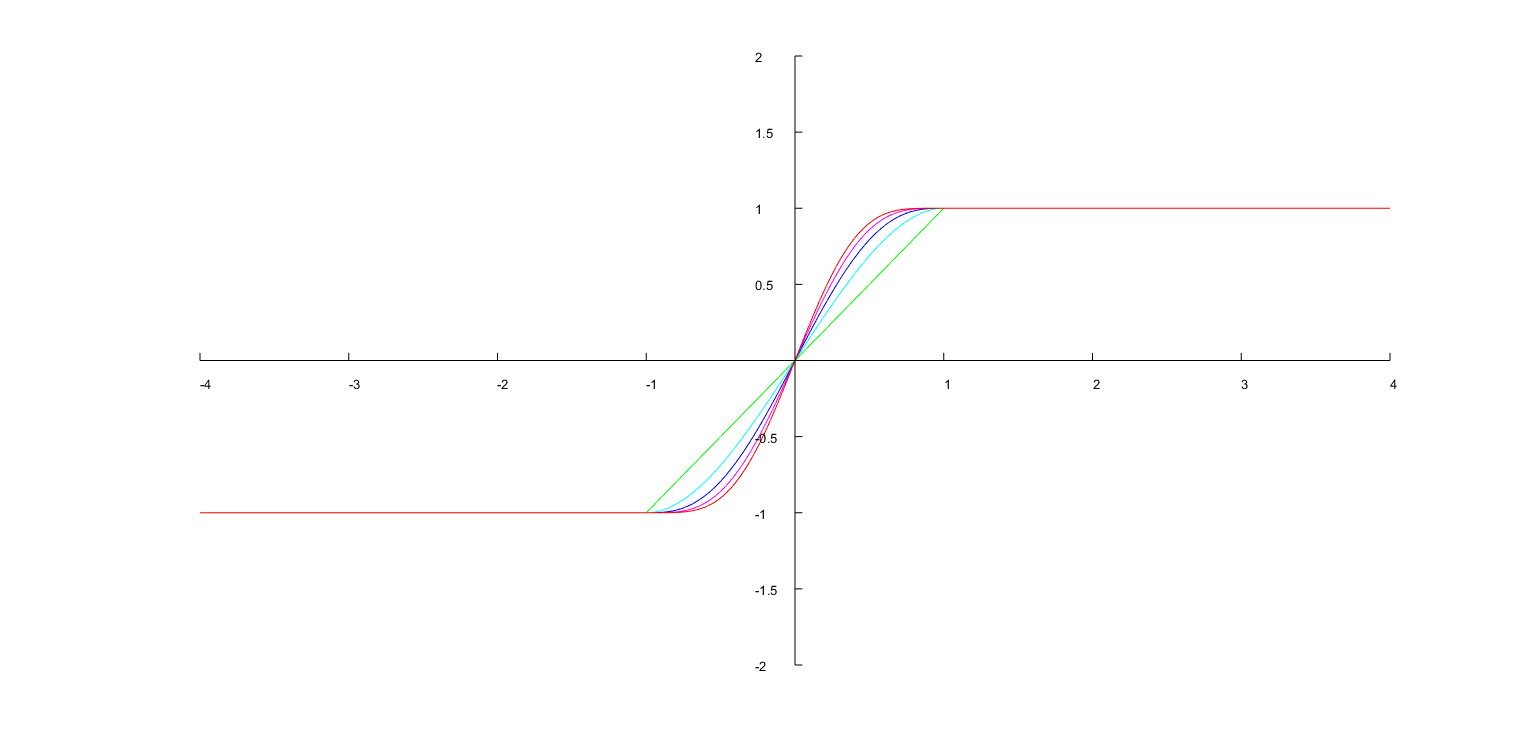
If we define a linearly-scaled and offset version of the Smoothstep polynomial as:
$$ \operatorname{R}_N(x) = 2\operatorname{S}_N\left( \tfrac12(x+1) \right) - 1 $$
Then this means that $\operatorname{R}_N(-1) = -1$, $\operatorname{R}_N(1) = 1$, and as many derivatives as possible at those two points are zero. And we see that $\operatorname{R}_N(0) = 0$ and that odd-symmetry exists: $\operatorname{R}_N(-x) = -\operatorname{R}_N(x)$
Can anyone show, with the least amount of pain possible, that the derivative of $\operatorname{R}_N(x)$ becomes
$$\begin{align} \operatorname{R}^{'}_{N}(x) &= \operatorname{S}^{'}_{N}\left( \tfrac12(x+1) \right) \\ &= \left( \sum\limits_{n=0}^{N} \frac{N!}{n! (N-n)!} \frac{(-1)^n}{2n+1} \right)^{-1} (1-x^2)^{N} \qquad ? \\ \end{align}$$
This is not homework (I haven't been in skool since the early '80s). This DSP question and answer show the previous work I have done with this. It's just a little bit bitchy and I am not sure the least painful way to go about doing this.
I guess that I am trying to show that
$$\begin{align} \operatorname{S}^{'}_{N}\left( \tfrac12(x+1) \right) &= \sum_{n=0}^{N} \binom{-N-1}{n}\binom{2N+1}{N-n}(N+n+1) \left(\tfrac12(x+1)\right)^{N+n} \\ &= \left( \sum\limits_{n=0}^{N} \frac{N!}{n!(N-n)!} \frac{(-1)^n}{2n+1} \right)^{-1} (1-x^2)^{N} \\ \end{align}$$
This really looks like a copulating female canine to me.
EDIT:
Here is the clearest way for me to state the question:
Let $x \in \mathbb{R}, \ N \ge 0 \in \mathbb{Z}$.
Define:
$$\begin{align} f_N & \triangleq \int\limits_{0}^{1} \big(1 - u^2 \big)^{N} \ du \\ & = \sum\limits_{n=0}^{N} \binom{N}{n} \frac{(-1)^n}{2n+1} \\ \end{align}$$
Define:
$$ \operatorname{R}_N(x) \triangleq \frac{1}{f_N} \int\limits_{0}^{x} \big(1 - u^2 \big)^{N} \ du $$
Define from the Wikipedia definition of the Smoothstep sigmoid-like function:
$$\operatorname{S}_N(x) \triangleq \sum\limits_{n=0}^{N} \binom{-N-1}{n}\binom{2N+1}{N-n} x^{N+n+1} $$
Prove:
$$ \operatorname{R}_N(x) = 2\operatorname{S}_N\big(\tfrac12 (x+1) \big) - 1 $$
It suffices to prove that their first derivatives of the left-hand and right-hand sides are equal, because we know the left-hand and right-hand sides are equal at $x=-1$. This means it is sufficient to show that:
$$ \frac{1}{f_N} (1-x^2)^{N} = \frac{d}{du}\,\operatorname{S}_N(u) \Bigg|_{u=\frac12 (x+1)} $$
or
$$ \frac{1}{f_N} (1-x^2)^{N} = \sum_{n=0}^{N} \binom{-N-1}{n}\binom{2N+1}{N-n} (N+n+1) \left(\tfrac12(x+1)\right)^{N+n} $$
or, explicitly:
$$ \left( \sum\limits_{n=0}^{N} \binom{N}{n} \frac{(-1)^n}{2n+1} \right)^{-1} (1-x^2)^{N} = \sum_{n=0}^{N} \binom{-N-1}{n}\binom{2N+1}{N-n} (N+n+1) \left(\tfrac12(x+1)\right)^{N+n} $$