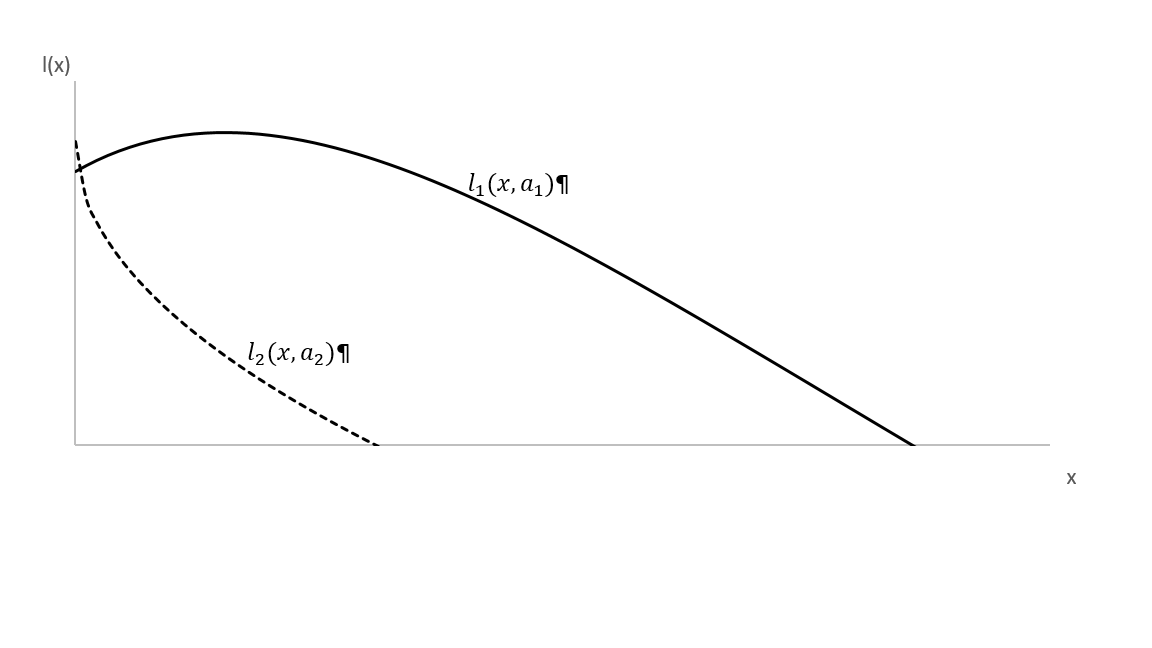
I have a question about quasi-concavity and the necessary conditions for a unique solution.
I have a function $l(x)$ which is a combination of different functions and I'm only interested in non-negative values for $l(x)$ in the first quadrant (it's a profit function). Furthermore $x$ is a closed set between $[0, x°]$ where $x°$ is the root for $l(x)$ with $x°<1$. Apart from that $l(x)$ also depends on some exogenous parameter, called $a$. Depending on the parameter value the function $l(x)$ is subject to a different behavior which is shown in this link (http://fs5.directupload.net/images/170314/sdkivdfv.png). Maybe I should note that the function has always a positive intersection with the y-axis and always a root in the closed set of $x$.
Therefore the function is either concave or monotone decreasing. As the user @mlc has pointed out to me in this post (Product of convex and concave functions) this seems to be a quasiconcave function which per definition is: $$f[\lambda x+(1-\lambda) y] \ge min [f(x), f(y)] $$
My problem is to proof that $l(x)$ is quasiconcave but this is my try so far. Remember that we are looking for the closed set of $[0, x°]$:
$$l[\lambda 0 + (1-\lambda) x°] \ge min [l(0), l(x°)]$$ we know that $l(x°)=0$ per definition and $l(0)$ is non-negative, therefore: $$l[ x°-\lambda x°] \ge min [l(x°)]$$ Because $x°-\lambda x°$ is always to the left of the zero of function $l(x)$ it can never be smaller which completes the proof.
Just for some further context: I'm trying to proof that $l(x)$ is quasi-concave so I can use the Arrow-Enthoven Theorem to say something about the number of extreme values (maxima).
I hope my comment is not too confusing and I hope someone can help me, thank you.
I was asked to give some additional information on $l(x)$. As I wrote above, $l(x)$ is the result of different functions, let's call them $f(x)$, $g(x)$ and $h(x)$ where $l(x)=(1−x)f(x)g(x)−h(x)$. The combination of $f(x)$ and $g(x)$ is hump-shaped but neither necessarily concave nor convex (it also depends on the value of the parameter $a$). The same is true for $h(x)$ which is also hump-shaped and neither necessarily concave nor convex. Apart from that $f(x°)g(x°)$ and h(x°) are never zero.