14

This has become increasingly crowded, so at the onset, let me state this:

My question is, is there some reason this is so linear that I'm not seeing? The only thing it seems to indicate to me is that there truly must be infinitely many twin primes.

I've previously posted a method that might have potential toward proving the twin prime conjecture:

If each prime were a bucket filled with at least one unique twin prime, infinite primes (proven) would imply infinite twin primes (conjectured only). Bucket twin primes as follows:

$(3pn-4, 3pn-2)$ where $p$ is a prime, and $n$ is some odd less than $p$. Not only does each $p$ within the first 4,000 generate at least one twin prime, but the quantity of twin primes created follows a very linear pattern!

This pattern appears more linear when considering primes of sufficiently large size. Also rather than curving toward $0$, it actually appears to curve upward lending credence to my proposition that there is no limit to the twin primes this pattern can create! Infinite twin primes created with finite steps at each iteration!

Here's the Mathematica notebook for your exploration as well as an image of what it does:

https://dl.dropboxusercontent.com/u/76769933/Twinprimeplotting.nb

original

My question is, is there some reason this is so linear that I'm not seeing? The only thing it seems to indicate to me is that there truly must be infinitely many twin primes.

Edit: A quick explanation of the graph: {x,y} points are created with {n, Length[twin]}. The x-axis then is "$n$" or the ordered number of primes. On this graph, displayed are the primes from 400 to 4000. The y-axis is the number of twin primes generated using $(3pn−4, 3pn−2)$ where $p$ is a prime, and $n$ is some odd less than $p$. Thus each prime trends toward generating a greater number of twin primes, also with greater variability. Sorry for the lack of clarity.

Also, here's a zoomed in graph to see detail better, and a table of data points to consider:

Zoomed

Table

  • 2
    this is a plot of what vs what? I don't find it easy to decipher the code you have supplied. Say $p=5$, then $n=3$ gives the twin-prime pair $(41,43)$. Do you plot the point $(5,3)$, or something else, on your graph? – Mirko Mar 30 '16 at 01:11
  • 2
    Whatever this is a plot of, it seems to become more sparse as it progresses to the right. Have you tested more points other than the ones that look pretty? If so, why not share your findings? – pseudoeuclidean Mar 30 '16 at 01:15
  • 1
    @Mirko The x-axis is "$n$" or the ordered number of primes. On this graph, displayed is primes from 400 to 4000. The y-axis is the number of twin primes generated using "$(3pn-4, 3pn-2)$ where $p$ is a prime, and $n$ is some odd less than $p$." Sorry for the lack of clarity. – Elem-Teach-w-Bach-n-Math-Ed Mar 30 '16 at 01:17
  • 1
    @pseudoeuclidean It does get more "sparse" in one sense or another. Problem is, I'm using what I can for free, and thus I have both memory and run-time limitations--part of the reason I posted the code for further exploration. From what I can find, the "sparseness" does continue, but consider what the sparseness means: simply that the number of twin primes generated from each prime has greater variation the larger $p$ becomes. A line fit of upper and lower limits might be revealing, but it seems both are still nearly upward trending lines. – Elem-Teach-w-Bach-n-Math-Ed Mar 30 '16 at 01:22
  • 1
    To help us understand your data, could you please provide a few sample points from your plot? – pseudoeuclidean Mar 30 '16 at 01:37
  • 3
    Thank you for the explanation,but it doesn't seem to help me(though it seems others got it,at least someone voted up your comment). Say $p=401$. The list of odd $n<p$ that give a twin-prime pair $(3pn-4,3pn-2)$ is $n\in{15,65,85,91,97,191,205,231,261,275,295,321,335,357}$, a list of length $14$. Does that mean you plot the point $(401,14)$? Thank you, a nice question! – Mirko Mar 30 '16 at 01:38
  • 1
    @Mirko I think yes. I voted up the comment. I'm a mad voter-upper. :D – Daniel Donnelly Mar 30 '16 at 01:41
  • Have you tried any variations like $5$ instead of $3$? – Daniel Donnelly Mar 30 '16 at 01:44
  • What is the slope of a linear regression line through those points? Kind of important! I calculated 8.3% slope visually. – Daniel Donnelly Mar 30 '16 at 01:49
  • @EnjoysMath Judging from the code Out[40]= $16.7854+0.0807996x$, looks like the slope is $0.0807996$ (though I do not follow the code). – Mirko Mar 30 '16 at 01:56
  • @EnjoysMath Yeah, definitely need a name change. Yours is much better than user####### ect. The 3 is actually intentional. I've found that only odd multiples of 3 times $p$ work, thus the $3np$ where $n$ is odd. Could you explain "slope of linear regression line"? Thanks – Elem-Teach-w-Bach-n-Math-Ed Mar 30 '16 at 02:38
  • @pseudoeuclidean I'll post a zoomed in pic of the first hundred or so so you can see individual points shortly. Great idea. – Elem-Teach-w-Bach-n-Math-Ed Mar 30 '16 at 02:39
  • @EnjoysMath Tried to reproduce the results from the graph independently,as a result of which my current interpretation of what is shown is the following. The 400-th prime number, $p_{400}=2741$, there are 52 odd $n<2741=p_{400}$ for which $(3p_{400}n-4,3p_{400}n-2)$ is a twin-prime pair. What is plotted is the point $(400,52)$. Similarly,the 4000-th prime number, $p_{4000}=37813$, there are 550 odd $n<37813=p_{4000}$ for which $(3p_{4000}n-4,3p_{4000}n-2)$ is a twin-prime pair. What is plotted is the point $(4000,550)$. Seems consistent with graph,and with OP explanation(which I didn't get ear – Mirko Mar 30 '16 at 02:42
  • @Mirko Absolutely right! Although your list doesn't match mine. Mine has length 47. How'd you get that list? – Elem-Teach-w-Bach-n-Math-Ed Mar 30 '16 at 02:45
  • 1
    I googled 400-th prime,web sites claim it is 2741.Then I used computer algebra Reduce http://reduce-algebra.com/ with the following code p:=2741;n:=0$for k:=1:(p/2)do if(primep(3(2k-1)p-4)and primep(3(2k-1)p-2))then n:=n+1;n;. This gives $n=39$. For $p_{4000}=37813$ I get $n=319$.(I had messed up code earlier when I got $n=52$ and $n=550$,respectively.But now I got 39,not 47.). The predicate $primep$ is built-in Reduce,don't know how it is implemented,perhaps probabilistically,though for such small numbers I think it would work right. – Mirko Mar 30 '16 at 03:00
  • @Mirko Go here (you may need a free account): lab.wolframcloud.com/app . Type this code in: Table[ q =3* Prime[n] Times@@@Subsets[Table[2*k-1, {k, 1,(Prime[n] + 1)/2}],{1}]; odd =twin/(3*Prime[n]); twin = Intersection[Select[q - 4, PrimeQ] + 4, Select[q - 2, PrimeQ]+2];{n,Prime[n],twin,Length[twin],odd}, {n, 401, 401}] (* {{Prime#, Prime, {list of numbers to subract 2 and 4 to get twin prime}, # of odds, {list of odds}"}}*) – Elem-Teach-w-Bach-n-Math-Ed Mar 30 '16 at 03:11
  • I didn't go to wolframcloud (thank you for the link though, may try another day), it is getting late, I am going to bed. But I think the discrepancy comes from confusing $p_{400}=2741$ with $p_{401}=2749$. Indeed, for $p=2749$ Reduce gives me $n=47$, which is what you had suggested. – Mirko Mar 30 '16 at 03:19
  • @Mirko Got it! 39 matches mine now too! – Elem-Teach-w-Bach-n-Math-Ed Mar 30 '16 at 03:22
  • @EnjoysMath Aww, I hadn't even come close to wading through that yet. – Elem-Teach-w-Bach-n-Math-Ed Mar 30 '16 at 05:10
  • Made a huge error in it. I'll let you know if I think of anything. – Daniel Donnelly Mar 30 '16 at 05:12
  • 3
    Welcome to number theory: there are lots of problems where we have mounds of empirical evidence, but nothing resembling a proof. Another example is the spacing between primes $p_{n+1}-p_n$: all the evidence points to this being very small, not much larger than $(\log p_n)^2$ at the widest. However, no one has been able to prove that it is smaller than $\sqrt{p_n}$. – Erick Wong Mar 30 '16 at 16:55
  • 1
    On the flip side, we also have phenomena that we can prove really does happen, but where it is impossible (with current algorithms and hardware) to calculate far enough to witness the phenomenon. So all the graphing in the world won't be enough to reveal the truth. – Erick Wong Mar 30 '16 at 16:59
  • @Erick Wong Thanks! If it were determined that there's a reason for the high $R^2$ of the best fit line, and that $R^2$ remains constant through an infinite number of primes, would that provide enough foundation for a proof? Or would the better direction to head be "Why the number of twin primes resulting from a large prime can never be 0"? – Elem-Teach-w-Bach-n-Math-Ed Mar 30 '16 at 17:56
  • 1
    @Elem-Teach-w-Bach-n-Math-Ed Sure but the hard part is proving "through an infinite number of primes". This isn't so much the basis of a proof as it is something that is harder to prove because it is a much stronger statement that we lack any tools to approach. It's also highly implausible that the R^2 value will stay constant in any sense. – Erick Wong Mar 30 '16 at 18:22
  • @Elem-Teach-w-Bach-n-Math-Ed Analogous situation, the Riemann Hypothesis can be phrased in terms of exactly how close the function $\pi(x)/\log x$ is to being a straight line of slope 1. That exact deviation is famously unsolved but we've known for 100 years that it is approximately a line slope 1. And we've known for 150 years that it doesn't drop below slope 1/2, and for 2000 years that there are infinitely many primes (so that it doesn't drop below the curve $C/\log x$). Someone waiting for RH to prove there are infinitely many primes would be waiting a loooooong time. – Erick Wong Mar 30 '16 at 18:28
  • You might be interested in a post I just made. Hopefully I'm not incorrect: http://math.stackexchange.com/questions/1721109/relating-prime-numbers-with-irreducible-polynomials-using-asymptotic-density-is – Daniel Donnelly Mar 31 '16 at 00:48
  • @EnjoysMath I am no longer convinced that I am seeing a straight line,it may be more like the graph of $\ln x$ or $\sqrt x$ concave down. For smaller primes,around $p_{150}$, the slope may be around $0.10$, for larger primes like posted by OP the slope may be around $0.08$, for yet larger primes like $p_{150010}=2015309$ the slope seems closer to $0.063$. As an extreme case,if you plot just two points they seem to lie on a straight line, and if you only plot a somewhat restricted interval of primes those too may suggest a straight line,interesting plot,seems close to a line,but may not be such – Mirko Apr 01 '16 at 03:04
  • @Mirko Daniel Lichtblau's comments in a similar Mathematica post I have here: mathematica.stackexchange.com/questions/111222/brute-force-evidence-of-possible-proof-of-twin-prime-conjecture seem to indicate he has an idea as to why this may be linear-ish. =) I don't get it at all, but maybe one of you all would. – Elem-Teach-w-Bach-n-Math-Ed Apr 01 '16 at 05:45
  • @Mirko Also, my statement, "This pattern appears more linear when considering primes of sufficiently large size." The first 400 do seem more curved. I simply thought that might have been a symptom of small input. It's probably not. If the slope never becomes negative though, and the "spread" never too wide... perhaps big unproven "ifs." – Elem-Teach-w-Bach-n-Math-Ed Apr 01 '16 at 06:07
  • Graph study shows that after the 4000th prime, you don't even need to test the smallest 1% of the odd candidates before finding a twin prime, with that % decreasing. In seeking to find a reason for all this behavior, I've been considering the fact that if there's a last twin prime, then there exists a prime $p$ after a final working $p$, such that when every odd is tested, (not just those less than $p$) none give a twin prime. I'm trying to find a reason for the impossibility of such a $p$'s existence using a derivative of the Chinese Remainder Theorem. – Elem-Teach-w-Bach-n-Math-Ed Apr 01 '16 at 06:27
  • Instead of considering $(3pn-4, 3pn-2)$ for prime $p$ and odd $n<p$ you may consider $(3mn-4, 3mn-2)$ for odd $m$ and odd $n<m$. You could make a plot similar to the one you already made, but with $m$ on the horizontal axis. I suspect that if you use a logarithmic scale on the horizontal axis then the plot may appear linear. Then instead of looking at the smallest prime $p$ that would not produce twin primes, you may look at the smallest odd $m$. Don't know why using primes $p$ or general odd $m$ might help, but you may try either approach, good luck :) – Mirko Apr 02 '16 at 02:43
  • @Mirko Very intriguing proposition! Definitely will have to look into this further. Initially, my thought is that this would eliminate the uniqueness of each twin. $3pn$'s uniqueness can be shown as $p$ is $3pn$'s largest prime factor for $n<p$. But as $m$ would possibly be composite, we cannot be sure of $3mn$'s largest prime factor or therefore it's uniqueness. For instance, $(n, m)=(5, 21)$ and $(3, 35)$ would have identical $3mn=315$. Those are my initial thoughts anyway. Let me know if that doesn't hold. – Elem-Teach-w-Bach-n-Math-Ed Apr 02 '16 at 05:13
  • Also, I've posted here: http://math.stackexchange.com/questions/1723517/reverse-of-chinese-remainder-theorem my thoughts on a possible method to show why each prime must generate a twin, but I have 17 views without a single comment. I don't think math is ready yet for the type of question I asked. – Elem-Teach-w-Bach-n-Math-Ed Apr 02 '16 at 05:17
  • I put a plot at https://i.sstatic.net/ac5MX.png On the x-axis odd $m$ run from 3 to 4001. On the y-axis, the number of good $n\le m$ that produce twin primes $(3mn-4, 3mn-2)$ is shown. For example, $m=9$ only produces one pair, when $n=m=9$ (so I chose to work with $n\le m$ than $n<m$). Did not use log scale (since it made the graph look concave up,so used usual linear scale as labeled). Plot is spread out compared to only using primes,seems that non-prime odd $m$ occasionally produce way too many good $n$.(Uniqueness is lost,but this is ok,a twin may only be repeated finitely many times.) – Mirko Apr 02 '16 at 05:23
  • An interesting thought! I'll have to look at this more tomorrow as time allows, and I'm not half asleep. =) Thanks, M! – Elem-Teach-w-Bach-n-Math-Ed Apr 02 '16 at 05:31

1 Answers1

12

I will add some extended comments. I do not know how to answer this question:

OP. My question is, is there some reason this is so linear that I'm not seeing? The only thing it seems to indicate to me is that there truly must be infinitely many twin primes.

In the above, I see one question, and two statements. The first statement is that the plot is "so linear". I am not convinced that it is indeed linear, and I comment on this below. (I admit it looked linear to me at first.) If the plot is not linear then formally the question is void, but I do find the plot interesting, and I provide some further support (in the form of more plots) that it is indeed more or less linear, if not in the sense of a "straight line" then at least in the sense of a "thin curve" (with a gradually decreasing slope, where perhaps slope remains positive all the time but who knows). I do not know if there is a reason for that (but on the other hand, there is a reason for everything :). From the plots below it seems that taking primes $p$ only, in $(3pn-4,3pn-2)$ (as opposed to taking odd numbers $m$ in general, in $(3mn-4,3mn-2)$) does seem to contribute to the "thinness" of the curve. Finally, concerning the statement that there truly must be infinitely many twin primes, it doesn't look like use of the word "truly" on its own constitutes a proof ;)

So, first I was confused as to what exactly was plotted, and eventually it was cleared (to me, after guessing incorrectly twice) in the comments. The OP also edited the question to supply a clarification, but I find it confusing to use the same letter $n$ in two inconsistent ways, on one hand $p=p_n$, the $n$-th prime, and, on the other hand, odd $n<p$, in $(3pn-4,3pn-2)$.

So, below $p_k$ will denote the $k$-th prime, like $p_1=2$, $p_2=3$, $p_3=5$, etc. What the OP does for primes $p$ could as well be done for odd integers $m\ge3$ in general. Given $m$ let $g(m)$ denote the quantity of good, odd $n<m$ for which $(3mn-4,3mn-2)$ is a twin-prime pair. For example, when $m=5$ then we could take $n=1,3$. Then $n=1$ is good since it results in the twin-prime pair $(3mn-4,3mn-2)=(11,13)$. Also, $n=3$ is good since it results in the twin-prime pair $(3mn-4,3mn-2)=(41,43)$. This $g(5)=2$ since there are two good values for $n$, namely $n=1$ and $n=3$, that work. On the other hand if $m=9$ then possible values for $n$ are $n=1,3,5,7$ and none of them is good. Indeed $n=1$ gives $(3mn-4,3mn-2)=(23,25)$, not good (as $25$ is not a prime), $n=3$ gives $(77,79)$ not good, $n=5$ gives $(131,133=7\cdot19)$ not good, and $n=7$ gives $(185,187)$ not good. Thus $g(9)=0$ (and it seems that $m=9$ is the only odd $m\ge3$ with $g(m)=0$, at least this is so, for $3\le m\le 55227$, as far as I computed).

One may contemplate variations of $g(m)$, for example $\bar g(m)$ would count the number of good odd $n\le m$ (instead of $n<m$), and $\tilde g(m)$ would count the number of good odd $n\le m^2$. Then for example $\bar g(9)=1$ since $n=9$ is good, resulting in twin-prime pair $(239,241)$. Also, $\tilde g(9)=9$. For now I will stick with $g(m)$, following OP, but it might be worth looking at versions of $g(m)$ obtained by replacing odd $n<m$ with odd $n\le b(m)$ for a suitable fixed bound function $b(m)$.

Using $g(m)$ we could define $f(k)=g(p_k)$, where $p_k$ is the $k$-th prime number. For example, $f(2)=g(3)=1$, $f(3)=g(5)=2$, $f(4)=g(7)=3$, and $f(400)=g(p_{400})=g(2741)=39$. My understanding is that the plot posted by the OP represents $f(k)$ vs $k$ for $k$ from $400$ to $4000$ (although this notation was not used). For example the point $(400,39)$ belongs to the plot.

As I noted in a comment, I am not convinced that I am seeing a straight line. If a larger range of values of $k$ is considered, then it seems that the plot is concave down, with the slope gradually decreasing. For smaller primes, around $p_{150}$, i.e. when $k=150$, the slope may be around $0.10$, for larger primes like posted by OP $400<k<4000$ the slope may be around $0.08$, for yet larger primes like $p_{150010}=2015309$, i.e. $k=150010$ the slope seems closer to $0.063$. (This is based on my computations and estimates using Computer Algebra Reduce, a link to this software is posted in the comments, it has a predicate primep$(p)$ returning true if $p$ is a prime. Using Reduce I made tables of values which were then used to make plots, using Graph of Ivan Johansen.)

Here is a plot of $f(k)$ vs $k$ for $2\le k\le5611$. Note that $p_{5611}=55219$.
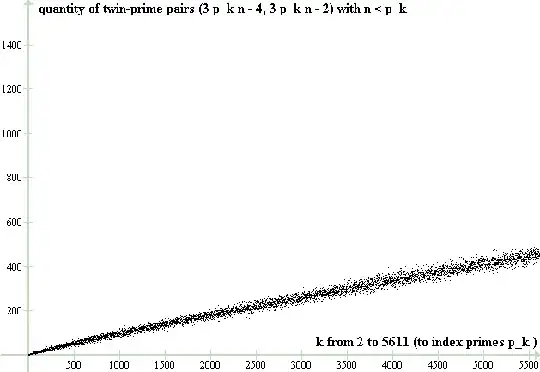
quantity if twin primes generated by $p_k$ for $k$ from $2$ to $5611$

This plot does resemble a straight line. But an estimate of its slope (using the right half of the plot) gives about $0.074$, whereas the OP has an estimate for the slope about $0.08$ or $0.081$ based on $400\le k \le 4000$. As noted earlier my estimate for the slope when $k=150010$ is less than $0.063$. If the slope is gradually decreasing then this is not a straight line. (Of course even if the "slope" appears to approach $0$ but remain positive all the time, then this will prove the infinitude of twin-prime pairs, but this would need more precise language and proofs.)

As I see no particular reason to only consider $n<p_k$ (as opposed to $n\le b(p_k)$ for a suitable fixed function $b$), I also do not see a formal reason to restrict these considerations to primes $p_k$ only. That is, $g(m)$ is defined for all odd $m\ge3$, not only for $m=p_k$, and we may try to plot it. A technical question arises: If we keep $k$ on the horizontal axis, then, given $m$, what $k$ does it correspond to? In the plot below I have chosen to plot the point $(k+\frac12,g(m))$ whenever $m\ge3$ is a composite odd number with $p_k<m<p_{k+1}$. Given the scales involved this choice seems just fine, and the plot below is an extension of the plot given earlier.
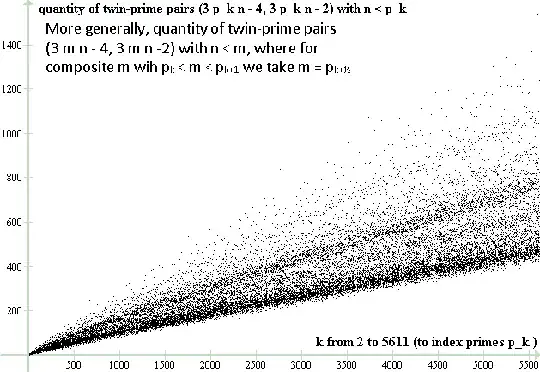
quantity if twin primes generated by not only primes $p_k$ for $k$ from $2$ to $5611$

Obviously the new plot (involving composite odd numbers as well as primes) is much more spread out, along the vertical, than the old plot (only involving primes). The primes seem to generate just one belt at the lower part of the plot, and there seem to be some structure, involving belts further up. I thought perhaps semi-primes have their own belt, but this does not seem to be the case. Although the plot for the semi-primes only, given below, is not spread out along the vertical direction nearly as much as the plot for all composite numbers, the plot for semi-primes seems nevertheless itself to include two or three belts (one of them coinciding with the belt coming from the primes). Lo and behold, is there a reason for all this, I guess someone working in number-theory may have a good laugh if the reason for them is obvious, but I didn't even try to figure it out, just making an observation (and contributing to the puzzle offered by the OP).
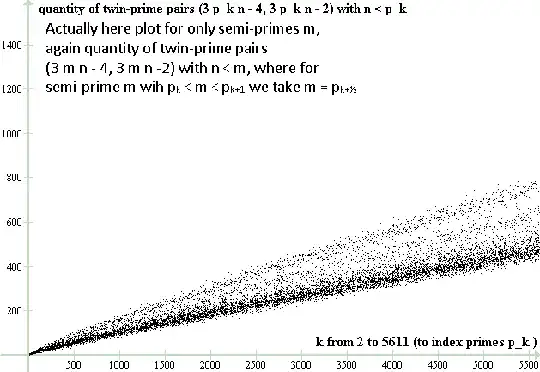
quantity if twin primes generated by not primes $p_k$, but semi-primes for $k$ from $2$ to $5611$

Here are all three plots, for primes, composites, and semi-primes together. (Composites in black, semi-primes painted over in green, and primes painted over in red.)
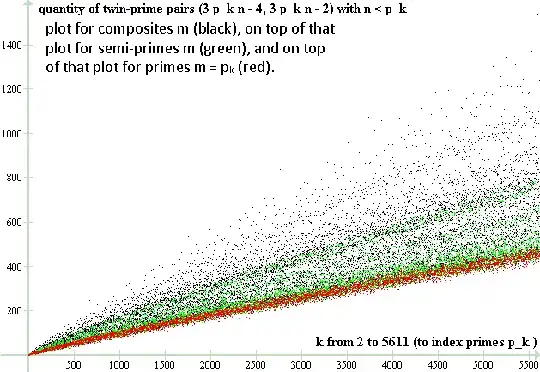
quantity if twin primes generated by composites (black), semi-primes (green) and primes $p_k$ (red), for $k$ from $2$ to $5611$

As already indicated, the above are plots of $f(k)=g(p_k)$ vs $k$. I had an incorrect interpretation earlier as to what was plotted by OP, I thought it was a plot of $g(m)$ vs $m$ (and I had included a link to a plot of $g(m)$ vs $m$ in the comments, just because it was quicker to make the plot that way). But the plot of $f(k)=g(p_k)$ vs $k$ looks better than the plot of $g(m)$ vs $m$ since the latter plot looks concave down in a more pronounced way, whereas the former looks more like a straight line, even if it is concave down too, when one looks more carefully. For comparison, here is the plot of $g(m)$ vs $m$ for $3\le m\le 55227$, which includes virtually the same range of primes as before, but, if $m=p_k$, then this time $m$ is on the horizontal axis instead of $k$.
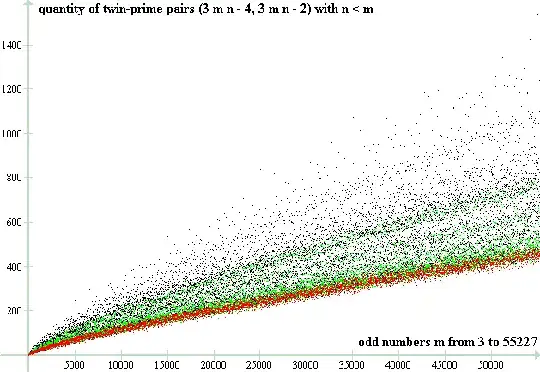
quantity if twin primes generated by composites (black), semi-primes (green) and primes $m$ (red), for odd $m$ from $3$ to $55227$

The OP had observed that: If each prime were a bucket filled with at least one unique twin prime, infinite primes (proven) would imply infinite twin primes (conjectured only). As discussed in the comments this uniqueness is lost when one considers $g(m)$ in general for odd $m\ge 3$ instead of only $f(k)=g(p_k)$ for primes $p_k$. More precisely, if $k<j$ and $n<p_k$ with $(3 p_k n - 4,3 p_k n - 2)$ a twin-prime pair, and if $l<p_j$ with $(3 p_j l - 4,3 p_j l - 2)$ a twin-prime pair, then necessarily $3 p_k n - 4\not=3 p_j l - 4$ since $p_k n\not=p_j l$ for the largest prime factor of $p_k n$ is $p_k$ while the largest prime factor of $p_j l$ is $p_j>p_k$. This uniqueness argument fails if $p_k$ is replaced by a general odd number $m$, but I am not concerned about this. Indeed $3 m n -4\ge 3 m -4$, and the numbers $3 m -4$ go to infinity as $m$ goes to infinity, so if there are infinitely many odd $m$ for each of which there is at least one good odd $n<m$, then this would imply the existence of infinitely many twin-prime pairs. Thus one possible modification of what the OP proposes is to simultaneously: (1) come up with a nice bounding function $b(m)$ so we consider all odd $n\le b(m)$ instead of odd $n<m$, and (2) come up with a suitable sub-sequence of the odd numbers, say a sequence $\{m_i:i=1,2,3\dots\}$ such that $g(m_i)$ is easy to evaluate, or at the very least such that one could show that $g(m_i)\ge1$ for each $i$. Restated in this way, I do not see how this problem would perhaps be any easier than the twin-prime conjecture itself, I see no suitable candidates for either $b(m)$ of for a sub-sequence of the odd primes (that is, I didn't really think about it, but I don't seem to have ideas how to start). With this notation, the OP seems to suggest that $b(m)=m-1$ is a natural answer for (1), and that the sequence of odd primes is a natural answer to (2). Perhaps these plots provide some evidence, but on one hand, these plots did not involve very large primes, and on the other hand even if one could precisely state what is seen on these plots and believe it, and even if it is true, one wouldn't know that it is true without a proof. What exactly do these plots show, if anything?

For more on why these plots look the way they do, one may google and listen to the song "Turn,Turn,Turn" by The Byrds (but I won't provide a link, as the answer there does not employ a mathematical argument. You might want to replace season with reason, as you listen ;)

Edit. It may be curious to look at some of the high points on these plots, corresponding to large yield $g(m)$ for some composite $m$ (compared to $g(m')$ for neighboring $m'$). Some of these are $g(15015)=536=g(p_{1755\frac12})$ (though notation $p_{k\frac12}$ is in general ambiguous since it may denote any of several composite numbers between $p_k$ and $p_{k+1}$), $g(19635)=656=g(p_{2225\frac12})$, $g(25025)=837=g(p_{2763\frac12})$, $g(35035)=1072=g(p_{3734\frac12})$, $g(45045)=1288=g(p_{4677\frac12})$, and $g(55055)=1537=g(p_{5595\frac12})$. All of these $m$ listed above except $19635$ are multiples of $1001=7\cdot11\cdot13$. More precisely, $15015=3\cdot5\cdot7\cdot11\cdot13$, $19635=3\cdot5\cdot7\cdot11\cdot17$, $25025=5^2\cdot7\cdot11\cdot13$, $35035=5\cdot7^2\cdot11\cdot13$, $45045=3^2\cdot5\cdot7\cdot11\cdot13$, $55055=5\cdot7\cdot11^2\cdot13$. Clearly twin-primes has something to do with Scheherazade. One may conjecture that when $m$ is highly composite (e.g. product of many, preferably different, small primes) then $g(m)$ is large. This is what the plots might suggest. (So called smooth numbers seem related, they have been studied for their applications in factoring algorithms, Wikipedia has a page on that.) One may look for a suitable sequence of odd integers, perhaps a sequence of suitably chosen(?) smooth numbers, say $\{m_i:i=1,2,3,\dots\}$ such that the plot of $g$, when restricted to these $m_i$ only, looks like a line, except that this "line" will have a "bigger slope" as compared to the "line" that goes with $g(p_k)$ for primes $p_k$.

Mirko
  • 13,789
  • 1
    I'm giving this a +1 for effort, though I haven't read it all. – goblin GONE Apr 10 '16 at 01:57
  • 1
    I did read it all! You da man Mirko! I realized from the get-go that I have little to no chance of proving the twin prime conjecture with my lack of advanced math learning. Thus, my goal was to provide something useful to the minds further advanced than my own that would stimulate increased thought in relation to a particular facet of twin primes. The length and depth of your post tells me I've succeeded! =D – Elem-Teach-w-Bach-n-Math-Ed Apr 10 '16 at 05:58
  • 1.nanos gigantum humeris insidentes: If I have seen further, it is by standing on the shoulders of giants. 2. I don't think I have "seen further" anyway, I find the above discussion interesting,but it is not clear where it will lead, no immediate consequences or what/how to do next. 3. I don't put myself into the category of "minds further advanced",number theory is not my specialty,but to keep using quotes, "What one fool can do, another can", so I think that if you keep working on this problem and learning more about it then with time you will become proficient enough to solve it on your own – Mirko Apr 10 '16 at 12:20
  • Thanks Mirko! It didn't alert me to this response for some reason or I would have responded sooner. I suppose I meant in analogy that others have more tools in their belt. The most advanced math courses I've taken are Calc 3 and Discrete Math and I've spent the last 5 years teaching 4th grade Arithmetic. I'll keep beating nails into the wall with wrenches and screwdrivers, but I appreciate when someone with a hammer comes along to help! – Elem-Teach-w-Bach-n-Math-Ed Apr 16 '16 at 18:28