22

I'm struggling with the following problem from Terence Tao's "Solving Mathematical Problems":

Suppose the teacher can run six times as fast as the boy can swim. Now show that the boy cannot escape. (Hint: Draw an imaginary square of sidelength 1/6 unit centred at $O$. Once the boy leaves that square, the teacher gains the upper hand.)

Here $O$ is the center of the swimming pool. This question is a follow up on the previous one, which is solved in the affirmative in the text

(Taylor 1989, p. 34, Q2). In the centre of a square swimming pool is a boy, while his teacher (who cannot swim) is at one corner of the pool. The teacher can run three times faster than the boy can swim, but the boy can run faster than the teacher can. Can the boy escape from the teacher? (Assume both persons are infinitely manoeuvrable.)


My attempt:

Since the boy can always swim back into the small square of sidelength 1/6 centered at $O$, I can't see how to apply the hint properly. Also, since the student's path need not even be smooth (it was taken as a polygonal chain in the previous question) I'm having difficulties writing data down clearly.

Any help would be appreciated. Thanks.

user1337
  • 24,859
  • Indeed the boy can stay in the pool indefinitely, but this doesn't amount to an "escape" in the sense of the earlier problem. – hardmath Dec 02 '15 at 02:47
  • @hardmath I understand what you're saying, but the hint implies that teacher should watch for the time where the student leaves the small square, and my problem is that he (the teacher) can never know when the student leaves that square for the last time. – user1337 Dec 02 '15 at 02:49
  • The boy should swim to the opposite corner of the pool. Isn't the point then just to show that the time it takes him to swim diagonally to the corner is greater than the time it takes for the teacher to get there around the square? Obviously in the "3 times faster" case the boy can make it to the corner before the teacher, but not in the second case. – Sam Weatherhog Dec 02 '15 at 02:52
  • The teacher can (and must) react the same way every time the boy leaves the inner region. It is somewhat easier to analyze a circular swimming pool since there are no distinguished points on the boundary. – hardmath Dec 02 '15 at 02:52
  • 1
    @SamWeatherhog Even in the "3 times faster" case, swimming to the opposite corner is too slow for the student. – user1337 Dec 02 '15 at 03:01
  • @hardmath I want to say that every time the student leaves the inner region the teacher should aim to get the point which is the unique positive multiple of the student's position which lies on the boundary of the pool. Is this the right approach? – user1337 Dec 02 '15 at 03:19
  • I believe the importance of the inner region is that by staying just inside it, the boy can swim to a position opposite from the teacher along a line passing through the center point $O$. Thus the worst case with which the teacher must cope is that of standing at corner of the pool when the boy reaches the "opposite corner" of the one-sixth square. – hardmath Dec 02 '15 at 03:25
  • 7
    Suppose the teacher can run six times as fast as the boy can swim. Now show that the boy cannot escape. Is that really all the information? What shape does the swimming pool have? What are their starting positions? – Eric S. Dec 18 '15 at 08:16
  • 1
    @EricS. As I've written above, this question is a follow up question on the one where the shape of the pool and the initial positions are defined. – user1337 Dec 18 '15 at 08:26
  • @user1337, Ah sorry, I've misread, my bad! – Eric S. Dec 18 '15 at 08:52
  • What about; every stroke the boy takes in the pool (i.e. 'time') allows the teacher to better position himself relative to the boy. So that if the boy deviates from a straight line between himself and the pool side, he will not use the most efficient path and thus 'give' even more 'time' to the teacher to catch him. And given the starting position in $O$, the best case scenario for the boy is to minimize his 'time' in the pool by swimming in a straight line to the pool side. Is this a correct assumption? – litmus Dec 22 '15 at 23:24
  • Also, can the boy can trick the teacher into oscillating between two sides at the same corner by swimming zig-zag towards the opposite corner? – litmus Dec 22 '15 at 23:25
  • @litmus in the case where the teacher runs 3 times faster, swimming straight to an edge is not a winning strategy, nor swimming to the opposite corner is. Also, I can't see how the zig zag trick works in our case. – user1337 Dec 23 '15 at 02:14
  • @user1337, I was thinking about the case where the teacher runs 6 times faster, but the "winning strategy" is only "as good as it gets" since it appears to me that the boy always gets caught. In the zig-zag case I was thinking about it shifting the shortest distance between the teacher and the boy between the two sides of the corner where the teacher starts (but I have no proof this works). – litmus Dec 23 '15 at 08:14
  • @user1337: in the case where the teacher runs $3$ times faster, swimming straight to the edge opposite the teacher is a perfectly adequate strategy (unless the teacher is standing at a corner, in which case the boy swims slightly away from the teacher). – TonyK Dec 23 '15 at 11:45
  • @TonyK I'm not arguing with that, but in the first question it says "while his teacher (who cannot swim) is at one corner of the pool." – user1337 Dec 23 '15 at 11:48
  • @user1337: So it does! I missed that somehow. – TonyK Dec 23 '15 at 11:51
  • Are we given the dimensions of the pool? If not, then how does this work out:
    1. The boy swims 1/12 of the distance parallel to one of the sides, and away from the teacher (the teacher follows him and reaches the midpoint of the side)
    2. Now the boy starts swimming perpendicularly away from the teacher to the opposite side (now the teacher has to cover slightly less than semi-perimenter (s))

    If sides are $a$ and $b$, ($b$>$a$) for the boy not escape, we need: $\frac{\frac{a}{2}}{v} \gt \frac{(a+b-\frac{b}{12})}{6v}$ where $v$ is the speed of the boy. My point being, is it solvable, at all?

    – tpb261 Dec 24 '15 at 09:31

4 Answers4

8

Definitions and assumptions (without loss of generality)

  • Without loss of generality, we can consider the teacher is on the bottom half corner (we know the teacher is in a corner and the problem is symmetrical).

  • Lets call the inner square the square of 1/6 unit of side, centered at the origin.

  • It takes at least $6\times \frac{1}{12} = \frac{1}{2}$ unit of time for the kid to reach the side of the inner square.

In that time, the teacher goes to the center of the bottom side of the pool, no matter where the boy goes.

When the kid leaves the inner square, teacher always go as close as possible to the kid. If the kid goes back inside the inner square, the teacher goes back to his original position.

Solving the problem

We will now show that in this situation, the boy cannot escape.

Case 1 : The boy exits the inner square at its bottom square

  • Obviously, the boy can't escape by the bottom side of the pool, since the teacher is here.

  • If he tries to escape by one side, it will take at least $6\times 5/12 = 2.5$ units of time. The teacher can be anywhere on the side in 1.5 unit of time.

  • If he tries to escape by the top, it will take at least $6\times 7/12 = 3.5$ units of time. The teacher can be anywhere on the top in 2.5 units of time.

Case 2 : The boy exits the inner square by one side (for example, the right side).

  • Again, the boy can't escape by the bottom because the teacher is here.

  • If the boy tries to escape on the right side, it will take at least $6\times 5/12 = 2.5$ units of time. The teacher can be anywhere on the side in 1.5 unit of time.

  • If the boy tries to escape on the left side, it will take at least $6\times 7/12 = 3.5$ units of time. The teacher can be anywhere on the side in 3.5 unit of time, even if he start by going through the right.

  • If the boy tries to escape on the top side , it will take at least $6\times 5/12 = 2.5$ units of time. The teacher can be anywhere on the side in 2.5 unit of time.

Case 3 : The boy exits on the top side

If the boy exits the inner square on the right half of the top, then, the teacher goes right. If the boy exits on the left half, the teacher goes left.

For the sake of the argument, let's say the boy exits the inner square on the right side (the situation is symmetric if he exits on the left).

  • The boy can't escape by the bottom (obvious).

  • If the boy tries to escape on the right side, it will take at least $6\times 5/12 = 2.5$ units of time. The teacher can be anywhere on the side in 1.5 unit of time.

  • If the boy tries to escape on the top side, it will take at least $6\times 5/12 = 2.5$ units of time. The teacher can be anywhere on the side in 2.5 unit of time.

  • If the boy tries to escape on the top half of the left side, it will take him at least $6\times 1/2 = 3$ units of time. The teacher can be on the top half of the left side in 3 units of time, even if he starts going on the right.

  • If the boy tries to escape on the bottom half of the left side of the pool. (this one is a bit more tricky)

Let $x$ be the distance between the escape point and the middle of the left side. The minimum time the kid takes to go there is :

$$T_{kid} = 6\times \sqrt{0.5^2 + (\frac{1}{12}+x)^2}$$

The time the teacher takes to get there, if he starts by going right is :

$$T_{teacher} = 3+x$$

We can show that $T_{kid}\geq T_{teacher}$, or

$$f(x) = T_{kid}- T_{teacher} = 6\times \sqrt{0.5^2 + (\frac{1}{12}+x)^2} - 3- x \geq 0$$

It could be done analytically, but I used wolfram alpha here to show it.

Conclusion

Since wherever the kid exits the inner square, he loses, the proof is complete.

Mike
  • 543
fredq
  • 970
2

The boy has no incentive to change direction since he loses time.

Which direction should he pick?

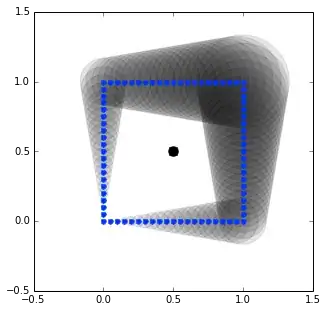
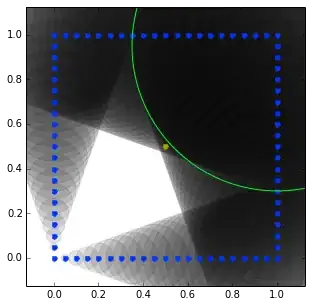
  • In the 6×speed case, no matter which direction the boy chooses, the teacher can get there faster.
  • In the 3×speed case, there are numerous directions where the boy can escape... just not the opposite diagonal corner.

enter image description here enter image description here

cactus314
  • 25,084
  • in the 3x speed, the boy can't escape if he goes straight to the opposite diagonal corner. It takes him $3\times \sqrt{0.5^2 + 0.5 ^2} \approx 2.1$ unit of time. The teacher gets there in 2 – fredq Dec 25 '15 at 07:37
0

Consider a square centred at $(0,0)$ in the Cartesian plane. Without loss of generality let the square have a side length of 2 units.

Suppose that the teacher is at vertex $(1,1)$.

Assume that there exists some point on the perimeter of the square with coordinates $(x,y)$ such that the student will arrive here before the teacher and so will escape. Due to the symmetry of the square, we can assume without loss of generality that $y=-1$. And so our point becomes $(x,-1)$.

Let the boy swim at $k$ $unit/s$ and let the teacher run at $6k$ $unit/s$

Then we have,

Distance from teacher= $2+(1-x)$ (distance travelled vertically down +distance travelled horizontally left towards point).

Distance from the student=$\sqrt{x^{2}+1}$

Time taken for teacher to reach this point $(t_{1})= \frac{3-x}{6k}$.

Time taken for student to reach this point $(t_{2})= \frac{\sqrt{x^{2}+1}}{k}$.

In order for the student to escape $(t_{1})>(t_{2})$,

hence, $\frac{3-x}{6k}>\frac{\sqrt{x^{2}+1}}{k}$.

Noting that $-1<x<0$ (i.e. the point we are looking for is in the third quadrant) reveals that this inequality does not hold in this interval.

J.Gudal
  • 1,353
  • It would work, in that case we would require $\frac{3-x}{3k}>\frac{\sqrt{x^{2}+1}}{k}$ which is satisfied at $(-0.5,-1)$. – J.Gudal Dec 24 '15 at 05:47
0

Consider a square of side length 1 unit. Consider 2 cases:

Case 1. Boy is at centre. Teacher is at corner. Boy swims to opposite corner. Distance for boy is 2/sqrt2 = 0.71 Distance for teacher is 1 + 1 = 2 But teacher is 6x faster. Therefore teacher beats boy.

Case 2. Boy is at centre. Teacher is at middle of a side. Boy swims to opposite side. Distance for boy is 1/2 = 0.5 Distance for teacher is 1/2 + 1 + 1/2 = 2 But teacher is 6x faster. Therefore teacher beats boy.

Boy can never escape.