2

According to my lecturer there are problems within this proof, but I can't for the life of me see what they are. It seems perfectly valid to me. Any help?
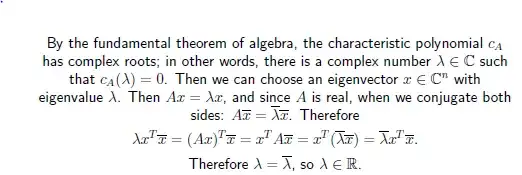

Click here to view it

Refnom95
  • 325
  • 4
    Still seems fine to me. Who told you it had problems? – Qiaochu Yuan Nov 22 '15 at 08:07
  • One issue is that you haven’t excluded the case $x=0$. – amd Nov 22 '15 at 08:13
  • 1
    @Refnom95: More is true: You could show that the eigenvectors could be chosen to be real and orthonormal. – Qmechanic Nov 22 '15 at 14:25
  • 2
    @amd: An eigenvector $x$ is by definition not a zero vector $x\neq 0$. – Qmechanic Nov 22 '15 at 15:42
  • It's an assignment. Apparently this proof wouldn't receive full marks. I have to identify the problems with it and say how I would fix it. – Refnom95 Nov 22 '15 at 16:15
  • 1
    @Qmechanic That may be so, yet the other proofs I’ve seen of this make a point of mentioning that the vector is nonzero. – amd Nov 22 '15 at 19:46
  • Any advance on what's already been said? All I can think is that there is some subtle mistake in the working on the second-to-last line. Are all the laws on the commutativity and associativity of matrix multiplication abode by? If it's definitely all valid then I'm lost and will have to roll with the restriction on x which just seems a bit flimsy. – Refnom95 Nov 23 '15 at 01:18
  • @Refnom95 sheldon's idea that the problem seems to be a flaw in the presentation rather than a computational mistake seems like the most likely problem. You say there exists an eigenvalue and prove it is real. That is neither a proof that all eigenvalues are real nor a proof by contradiction, but somewhere in between. – rschwieb Nov 23 '15 at 04:17
  • Related: https://math.stackexchange.com/q/354115 – Rodrigo de Azevedo Aug 08 '20 at 13:39

1 Answers1

3

Your lecturer is correct: there is a lot wrong with the proof above. The result (that every eigenvalue of a real symmetric matrix is real) has nothing to do with the Fundamental Theorem of Algebra---if the characteristic polynomial had no complex roots, then there would be no eigenvalues and the claimed result would be trivially true. The quantifier in the proof above is wrong because we are not interested in the existence of a complex root of the characteristic polynomial but in a property of all such roots. The result above also has nothing to do with the characteristic polynomial.

Here is a correct proof: Suppose $A$ is a real symmetric matrix and $\lambda \in \mathbb{C}$ is an eigenvalue of $A$. Then there exists a nonzero vector $x \in \mathbb{C}^n$ such that $Ax = \lambda x$. Now proceed as in the last four lines of the proof as given above.