40

For $x,y,z >0$, prove that $$\frac{x}{y+z}+\frac{y}{z+x}+\frac{z}{x+y} \geqslant \sqrt{\frac94+\frac32 \cdot \frac{(y-z)^2}{xy+yz+zx}}$$

Observation:

  1. This inequality is stronger than the famous Nesbitt's Inequality $$\frac{x}{y+z}+\frac{y}{z+x}+\frac{z}{x+y} \geqslant \frac32 $$ for positive $x,y,z$
  2. We have three variables but the symmetry holds only for two variables $y,z$, resulting in a very difficult inequality. Brute force and Largrange Multiplier are too complicated.
  3. The constant $\frac32$ is closed to the best constant. Thus, this inequality is very sharp, simple AM-GM estimation did not work.

Update: As point out by Michael Rozenberg, this inequality is still unsolved

HN_NH
  • 4,511

5 Answers5

15

Here's a proof.

Using Lagrange's identity leads to $$\sum_{cyc}\frac{x}{y+z}=\frac32+\frac12\sum_{cyc}\frac{(x-y)^2}{(x+z)(y+z)} \qquad (*)$$

We get this by letting $a = \sqrt{x+y}$, $b = \sqrt{y+z}$, $c = \sqrt{z+x}$, $d = \frac{1}{\sqrt{x+y}}$, $e = \frac{1}{\sqrt{y+z}}$, $f = \frac{1}{\sqrt{z+x}}$, and by Lagrange's identity, $$(a^2+b^2+c^2)(d^2+e^2+f^2) = (ad+be+cf)^2 + (ae-bd)^2+(af-cd)^2+(bf-ce)^2$$ which gives $$2 (x+y+z)(\sum_{cyc}\frac{1}{y+z}) = 9 + \sum_{cyc} \left(\frac{\sqrt{x+y}}{\sqrt{y+z}} - \frac{\sqrt{y+z}}{\sqrt{x+y}}\right)^2$$ or $$3 +\sum_{cyc}\frac{x}{y+z} = \frac92 + \frac12\sum_{cyc} \frac{\left({x+y} - (y+z)\right)^2}{({y+z})(x+y)} $$ which is the desired equation $(*)$.

Squaring both sides of the inequality then gives

$$ \tag{1} \frac16 \left[ \sum_{cyc}\frac{(x-y)^2}{(x+z)(y+z)} \right ]^2 + \sum_{cyc}\frac{(x-y)^2}{(x+z)(y+z)} \geq \frac{(y-z)^2}{xy + yz + xz} $$

We will follow two paths for separate cases.

Path 1: Omitting the square term it suffices to prove $$\sum_{cyc}\frac{(x-y)^2}{(x+z)(y+z)} \geqslant \frac{(y-z)^2}{xy + yz + xz}$$

Clearing denominators, we obtain $$ (x-y)^2 (x+y) + (y-z)^2 (y+z) + (z-x)^2 (z+x) \geq \frac{(y-z)^2}{xy + yz + xz} (x+y) (y+z) (z+x) $$

Using $(x+y)(y+z)(x+z) = (x+y+z)(xy + yz+ xz) - x y z$ it suffices to show

$$ (x-y)^2 (x+y) + (y-z)^2 (y+z) + (z-x)^2 (z+x) \geq {(y-z)^2} (x+y+z) $$ or $$ (x-y)^2 (x+y) + (z-x)^2 (z+x) \geq (y-z)^2 x $$

Since $$ (y-z)^2 = (y-x + x- z)^2 = (y-x)^2 + (x- z)^2 + 2 (y-x)(x-z) $$ this translates into

$$ (y-x)^2 y + (x-z)^2 z \geq 2 x(y-x)(x-z) $$ For the two cases $y\geq x ; z\geq x $ and $y\leq x ; z\leq x $ the RHS $\leq 0$ so we are done. For the other two cases, by symmetry, it remains to show the case $y> x ; z < x $.

Rearranging terms, we can also write $$ (y-x)^3 - (x-z)^3 +x ((y - x) + (z-x))^2 \geq 0 $$

This holds true at least for $(y-x)^3 \geq (x-z)^3$ or $y+z\geq 2 x$.

So the proof is complete other than for the case $y+z < 2x$ and [ $y> x ; z < x $ or $z> x ; y < x $ ].

Path 2.

For the remaining case $y+z < 2 x $ and [$y> x ; z < x$ or $z> x ; y < x $] we will follow a different path. Again, by symmetry, we must inspect only $y+z < 2x$ and $y> x > z$.

A remark up front: In the following, some high order polynomials of one variable have to be inspected. MATLAB is used, also for plotting behaviours of these polynomials. There is no case in spending effort for further analytical work on polynomials where their behaviour is obvious. Still, what follows contains some "ugly" parts.

In the squared version (1) of the inequality, we can use a further inequality which has been proved here: $$\sum_{cyc}\frac{(x-y)^2}{(x+z)(y+z)} \geqslant \frac{27}{8} \frac{(y-z)^2}{(x+y+z)^2}$$

So it suffices to prove

$$ \frac16 \left[ \frac{27}{8} \frac{(y-z)^2}{(x+y+z)^2} \right ]^2 + \sum_{cyc}\frac{(x-y)^2}{(x+z)(y+z)} \geq \frac{(y-z)^2}{xy + yz + xz} $$

Some numerical inspection shows immediately that the first term cannot be ommitted.

Clearing some denominators gives

$$ \tag{2} \frac16 \left[ \frac{27}{8} \right ]^2 \frac{(y-z)^4 (xy + yz + xz) (x+y)(y+z) (z+x)}{(x+y+z)^4} + \\ (xy + yz + xz) \sum_{cyc} {(x-y)^2}{(x+y)} - (y-z)^2 (x+y)(y+z) (z+x) \geqslant 0 \quad $$

By homogeneity, we set $y=1+z$.

The condition $y+z < 2x$ then translates into $1+2z < 2x$, hence we further set $x = z + (1 +q)/2$ where $0\leq q \leq 1$ since also $x = z + (1 +q)/2 < y = 1 +z$.

Inserting $y=1+z$ and $x = z + (1 +q)/2$ into (2) is straightforward, the result is lengthy (not displayed here).

Let us start with focussing on the first term in (2), calling that fraction $F$: $$ F= \frac{(y-z)^4 (xy + yz + xz) (x+y)(y+z) (z+x)}{(x+y+z)^4} $$ With the setting $y=1+z$ this can be simplified to $$ F = \frac{(xy + yz + xz) (x+y)(y+z) (z+x)}{(x+y+z)^4} $$

Since by the settings $y=1+z$ and $x = z + (1 +q)/2$ both x and y are linear in z, the numerator of $F$ is of fifth order in $z$, whereas the denominator is of fourth order in $z$. In leading order, the whole term is therefore of first order in $z$ and will therefore rise with $z$ for large enough $z$. This motivates to show that indeed $$F(q,z) \geq F(q,z=0) = 2 \frac{(q+1)^2}{(q+3)^2}$$ for all $z$ and $q$. Showing that directly requires a condition

$$ G = (xy + yz + xz) (x+y)(y+z) (z+x) (q+3)^2 - 2 (q+1)^2 (x+y+z)^4 \geq 0 $$

Inserting $y=1+z$ and $x = z + (1 +q)/2$ into $G$, and expanding the brackets, gives a very lengthy expression which however contains only positive terms, so the condition is proved immediately:

$$ G = (z(2q^6z + 2q^6 + 22q^5z^2 + 51q^5z + 22q^5 + 80q^4z^3 + 358q^4z^2 + 357q^4z + 100q^4 + 96q^3z^4 + 960q^3z^3 + 1828q^3z^2 + 1206q^3z + 260q^3 + 864q^2z^4 + 3672q^2z^3 + 4788q^2z^2 + 2484q^2z + 450q^2 + 2592qz^4 + 7344qz^3 + 7398qz^2 + 3159qz + 486q + 2592z^4 + 5832z^3 + 4806z^2 + 1701z + 216))/4 \geq 0 $$

Hence it suffices, instead of (2), to prove the following:

$$ \tag{3} \frac16 \left[ \frac{27}{8} \right ]^2 2 \frac{(q+1)^2}{(q+3)^2} + (xy + yz + xz) \sum_{cyc} {(x-y)^2}{(x+y)} \\ - (x+y)(y+z) (z+x) \geqslant 0 \quad $$

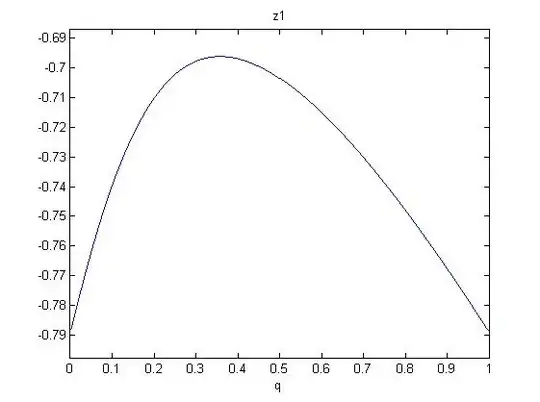
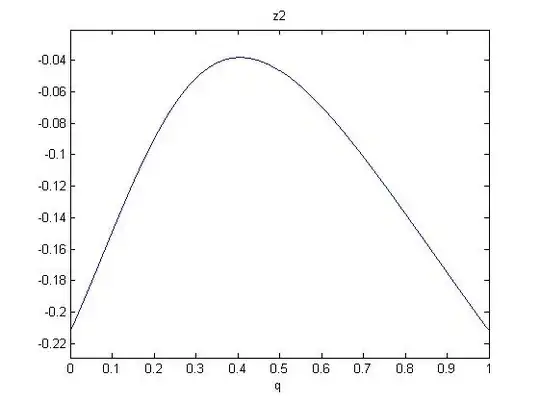
After insertion of $y=1+z$ and $x = z + (1 +q)/2$, the factors $(x-y)^2$ in the cyclic sum will not be functions of $z$. Hence, the LHS is a third order expression in $z$ with leading (in $z^3$ ) term $( 1 + 3 q^2) z^3$, so for large enough $z$ it is rising with $z$. A remarkable feature of this expression is that for the considered range $0\leq q \leq 1$ it is actually monotonously rising for all $z$. To see this, consider whether there are points with zero slope. The first derivative of the expression with respect to $z$ is

$$ q^4/4 + (7q^3z)/2 + (7q^3)/4 + 9q^2z^2 + 9q^2z + (5q^2)/4 - (7qz)/2 - (7q)/4 + 3z^2 + 3z + 1/2 $$ Equating this to zero gives $$ z_{1} = -(2((13q^6)/4 + (17q^4)/2 + (133q^2)/4 + 3)^{(1/2)} - 7q + 18q^2 + 7q^3 + 6)/(36q^2 + 12)\\ z_{2} = -(-2((13q^6)/4 + (17q^4)/2 + (133q^2)/4 + 3)^{(1/2)} - 7q + 18q^2 + 7q^3 + 6)/(36q^2 + 12) $$ One now shows that in the range $0\leq q \leq 1$, there are only negative solutions $z_{1,2}$. So we will have no zero slopes for $z\geq 0$. Since the polynomials are (roots of) sixth order in q, we investigate the following figures:
enter image description here

enter image description here

enter image description here

So monotonicity (rising with $z$) is established for all $q$.

Hence, to show the inequality it suffices to inspect (3) at the smallest $z=0$. This gives

$$ ((q + 1)(8q^6 + 88q^5 + 336q^4 + 432q^3 - 216q^2 - 405q + 243))/(64(q + 3)^3) \geqslant 0 \quad $$ or

$$ \tag{4} 8q^6 + 88q^5 + 336q^4 + 432q^3 - 216q^2 - 405q + 243 \geqslant 0 \quad $$

An even stronger requirement is $$ h(q) = 432q^3 - 216q^2 - 405q + 243 \geq 0 $$ In the considered range $0\leq q \leq 1$, $h(q)$ has a minimum which is obtained by taking the first derivative, $$ 1296 q^2 - 432 q - 405 $$ and equating to zero, which gives $q = 3/4$, and the above $h(q)$ then gives $$ h(q = 3/4) = 0 $$

This establishes the inequality. $ \qquad \Box$

Andreas
  • 16,627
11

Since our inequality is symmetric on $y$ and $z$ , we need to check two cases:

  1. $x=\min\{x,y,z\}$.

Let $y=x+u$ and $z=x+v$. Hence, $$4\prod_{cyc}(x+y)^2(xy+xz+yz)\left(\left(\sum\limits_{cyc}\frac{x}{y+z}\right)^2-\frac{9}{4}-\frac{3(y-z)^2}{2(xy+xz+yz)}\right)=$$ $$=192(u^2+uv+v^2)x^6+48(10u^3+13u^2v+13uv^2+10v^3)x^5+$$ $$+48(10u^4+17u^3v+18u^2v^2+17uv^3+10v^4)x^4+$$ $$+4(62u^5+133u^4v+158u^3v^2+158u^2v^3+133uv^4+62v^5)x^3+$$ $$+(68u^6+192u^5v+225u^2v^4+298u^3v^3+225u^2v^4+192uv^5+68v^6)x^2+$$ $$+(8u^7+40u^6v+34u^5v^2+66u^4v^3+66u^3v^4+34u^2v^5+40uv^6+8u^7)x+$$ $$+uv(u+v)^2(4u^4-6u^3v+11u^2v^2-6uv^3+4v^4)\geq0;$$ 2. $x\neq\min\{x,y,z\}$.

Let $x=y+u$ and $z=y+v$. Hence, $$4\prod_{cyc}(x+y)^2(xy+xz+yz)\left(\left(\sum\limits_{cyc}\frac{x}{y+z}\right)^2-\frac{9}{4}-\frac{3(y-z)^2}{2(xy+xz+yz)}\right)=$$ $$=192(3u^2-3uv+v^2)y^6+48(26u^3-3u^2v-19uv^2+10v^3)y^5+$$ $$+48(22u^4+21u^3v-26u^2v^2-7uv^3+10v^4)y^4+$$ $$+4(110u^5+253u^4v-58u^3v^2-226u^2v^3+37uv^4+62v^5)y^3+$$ $$+(92u^6+384u^5v+201u^2v^4-374u^3v^3-231u^2v^4+144uv^5+68v^6)y^2+$$ $$+2(4u^7+32u^6v+41u^5v^2-15u^4v^3-51u^3v^4-7u^2v^5+20uv^6+4u^7)y+$$ $$+uv(u+v)^2(4u^4-u^2v^2-6uv^3+4v^4)\geq0.$$ Done!

For example, $$4u^4-u^2v^2-6uv^3+4v^4=(2u^2-v^2)^2+3(u-v)^2\geq0;$$ Also, by AM-GM $$4u^7+32u^6v+41u^5v^2-15u^4v^3-51u^3v^4-7u^2v^5+20uv^6+4u^7=$$ $$=(u+v)(4u^6+28u^5v+13u^4v^2-28u^3v^3-23u^2v^4+16uv^5+4v^6)=$$ $$=(u+v)((2u^3+7u^2v-9uv^2+v^3)^2+(94u^3-118u^2v+34uv^2+3v^3)v^3)\geq$$ $$\geq v^3(u+v)(94u^3-118u^2v+34uv^2+3v^3)=$$ $$=v^3(u+v)\left(9\cdot\frac{94}{9}u^3+7\cdot\frac{34}{7}uv^2+3v^3-118u^2v\right)\geq$$ $$\geq v^3(u+v)\left(17\sqrt[17]{\left(\frac{94}{9}\right)^9\left(\frac{34}{7}\right)^7\cdot3}-118\right)u^2v\geq0.$$

  • great proof! by the way are you some olympiad coach? – vidyarthi Jan 31 '17 at 13:06
  • 1
    @vidyarthi Yes. I one of Israeli team coaches. – Michael Rozenberg Jan 31 '17 at 13:16
  • @MichaelRozenberg Typo in the last line of case 1 where $−6uv^3$ appears twice. – Andreas Feb 08 '17 at 10:15
  • @MichaelRozenberg Leaves open a number of smaller proofs to establish that all 14 coefficients of the powers of x and y are nonnegative. This is obvious for 5 coefficients which have only positive summands but not obvious for the other 9. – Andreas Feb 08 '17 at 10:15
  • @MichaelRozenberg Dear Michael, my best congratulations to you on having reached 10k reputation today! You have contributed tremendously and even accelerated over the last months! Good to have you around! Very best regards, Andreas – Andreas Feb 08 '17 at 18:33
  • @Andreas Thank you! For me too, good to have you around! I fixed my post. Which polynomial do you think hard to prove that it's non-negative? – Michael Rozenberg Feb 08 '17 at 18:44
  • @MichaelRozenberg Well, all of them, that is all 9 polynomials with negative terms arise the question whether they are positive for all positive $u,v$. I didn't say whether this is hard to prove,I just figured that you didn't rise that issue. – Andreas Feb 08 '17 at 20:25
  • @Andreas I added something. See now. I am ready to take another polynomial if you want. Say me only. – Michael Rozenberg Jul 27 '19 at 11:41
  • @MichaelRozenberg Dear Michael, thanks for adding the nonnegativity of one polynomial. Yes, I hold that for completeness of the proof, nonnegativity should be shown for all 9 polynomials. – Andreas Jul 31 '19 at 07:44
3

Alternative solution: (with the help of computer)

WLOG, assume $z = 1$. Let $p = x + y, q = xy$. The desired inequality is written as $$\frac{p + p^2 - 2q}{1 + p + q} + \frac{1}{p} \ge \sqrt{\frac94 + \frac32 \frac{p^2 - 4q}{p + q}}.$$ We have \begin{align*} &\left(\frac{p + p^2 - 2q}{1 + p + q} + \frac{1}{p}\right)^2 - \left(\frac94 + \frac32 \frac{p^2 - 4q}{p + q}\right)\\ =\ & \frac{q^3}{4(p + q)(1 + p + q)^2p^7}(c_3Q^3 + c_2Q^2 + c_1Q + c_0) \end{align*} where \begin{align*} Q &= \frac{p^2 - 4q}{4q}, \\ c_3 &= 256\,{p}^{6}+128\,{p}^{5}-576\,{p}^{4}-512\,{p}^{3}+192\,{p}^{2}+512\,p+256 , \\ c_2 &= 64\,{p}^{7}+448\,{p}^{6}+208\,{p}^{5}-1408\,{p}^{4}-1232\,{p}^{3}+832 \,{p}^{2}+1600\,p+768, \\ c_1 &= 40\,{p}^{7}+244\,{p}^{6}+56\,{p}^{5}-1104\,{p}^{4}-896\,{p}^{3}+1088\, {p}^{2}+1664\,p+768, \\ c_0 &= 7\,{p}^{7}+36\,{p}^{6}-20\,{p}^{5}-272\,{p}^{4}-176\,{p}^{3}+448\,{p}^ {2}+576\,p+256. \end{align*} Clearly, $Q \ge 0$. We can prove that $c_3, c_2, c_1, c_0\ge 0$ for all $p\ge 0$.

We are done.

River Li
  • 49,125
0

Partial answer.

Lemma 1 :

$a,b,c>0$ then we have :

$$\sum_{cyc}\frac{a}{b+c}\geq P(a,b,c)=\sqrt{\frac{9}{4}+\frac{9}{4}\frac{(c^4+a^4+b^4-c^2a^2-b^2a^2-c^2b^2)}{((a+b+c)\frac{3}{4}+\frac{3}{4}(abc)^{\frac{1}{3}})(a+b)(b+c)(c+a)}+\frac{(c^2+a^2+b^2-ca-ba-cb)(a+b+c)}{(a+b)(b+c)(c+a)}}$$

Proof of lemma 1 :

First we remark that the inequality is homogenous and we can try the substitution $3u=a+b+c$, $3v^2=ab+bc+ca$ and $w^3=abc$ and apply the uvw's method .

We have : $$a^4+b^4+c^4=(9u^2-6v^2)^2-2(9v^4-6uw^3)$$ $$a^2b^2+b^2c^2+c^2a^2=9v^4-6uw^3$$ $$a^2+b^2+c^2=9u^2-6v^2$$

And : $\left(\frac{((3u)((3u)^2-4(3v^2))+5w^3)}{3u3v^2-w^3}+2\right)^2\geq \frac{9}{4}+\frac{(9/4)((9u^2-6v^2)^2-2(9v^4-6uw^3)-(9v^4-6uw^3))+(2.25u+0.75w)(9u^2-9v^2)(3u)}{(2.25u+0.75w)(3u3v^2-w^3)}$

it's enough to find an extreme value of our expression for the extreme value of $w^3$ wich happens for an equality case of two variables .

Since the last inequality is homogeneous, we can assume that $b=c=1$.

$$\frac{2}{a+1}+\frac{a}{2}\geq\sqrt{\frac{9}{4}+\frac{9}{4}\frac{(a^4+1-2a^2)}{((a+2)\frac{3}{4}+\frac{3}{4}(a)^{\frac{1}{3}})(a+1)^2(2)}+\frac{(a^2+1-2a)(a+2)}{(a+1)^2(2)}}$$

Now it seems to be clear : we get a polynomial with a root equal to one . See the factorization by Wolfram alpha .

End of the proof of the lemma 1

With the assumption (wich makes the partial answer) $1\geq a\geq b \geq c>0$ $$P(a,b,c)\geq \sqrt{\frac94+\frac32 \cdot \frac{(a-b)^2}{ab+bc+ca}}$$

To prove it we have :

$$P(a,b,c)\geq\sqrt{\frac{9}{4}+\frac{3}{2}\frac{(a-b)^2(a+b+c)}{(a+b)(b+c)(c+a)}}\geq \sqrt{\frac94+\frac32 \cdot \frac{(a-b)^2}{ab+bc+ca}}$$

Wich is really smooth (proving the inequality term by term or fraction by fraction).Conclude using the lemma 1.

For the other case it's true with the assumption $a\geq c \geq b \geq \frac{a}{9}$ but currently I cannot prove it !

Update 14/04/2021 :

Conjecture :

Let $a,b,c>0$ then we have :

$$\sum_{cyc}\frac{a}{b+c}\geq\sqrt{\frac{9}{4}+\frac{9}{4}\frac{(c^4+a^4+b^4-c^2a^2-b^2a^2-c^2b^2)}{(0.75(abc)^{\frac{1}{3}}+0.75(a+b+c))(a+b)(b+c)(c+a)}+\frac{(c^2+a^2+b^2-ca-ba-cb)(a+b+c)}{(a+b)(b+c)(c+a)}+4\left(abc\frac{\left(\frac{a^2+b^2+c^2}{ab+bc+ca}-1\right)^4}{a^3+b^3+c^3}\right)}\geq\sqrt{\frac{9}{4}+\frac{3}{2}\frac{(a-b)^2}{ab+bc+ca}}$$

Update 16/04/2021 :

For the LHS I think we can use the uvw's method or Buffalo's way using a computer (I'm not againt the "computer-proof" if you want to know).The problem is :if we use the Tej's theorem it's sufficient to show a symmetric inequality when $a=b=1$ with a degree less than $5$ wich is not the case here .In the case where Tej's theorem works we have the following factorization by WA .See also the reference On the Abstract Concreteness Method (bka $ABC-$Method). .

It seems that we have the following inequalities :

Let $a,b,c>0$ :

$$\frac{(c^2+a^2+b^2-ca-ba-cb)(a+b+c)}{(a+b)(b+c)(c+a)}\geq \frac{3}{4}\frac{(a-b)^2}{ab+bc+ca}$$

$a,b,c\in[0.5,1]$

$$\frac{9}{4}\frac{(c^4+a^4+b^4-c^2a^2-b^2a^2-c^2b^2)}{(\frac{3}{4}(abc)^{\frac{1}{3}}+\frac{3}{4}(a+b+c))(a+b)(b+c)(c+a)}\geq \frac{3}{4}\frac{(a-b)^2}{ab+bc+ca}$$

$a,b,c\in[0.2,1]$ then we have :

$$\frac{9}{4}\frac{(c^{4}+a^{4}+b^{4}-c^{2}a^{2}-b^{2}a^{2}-c^{2}b^{2})}{(0.75(abc)^{\frac{1}{3}}+0.75(a+b+c))(a+b)(b+c)(c+a)}+8\left(abc\frac{\left(\frac{a^{2}+b^{2}+c^{2}}{ab+bc+ca}-1\right)^{4}}{a^{3}+b^{3}+c^{3}}\right)-\frac{3}{4}\frac{(a-b)^{2}}{ab+bc+ca}\geq 0$$ And

$$\frac{(c^{2}+a^{2}+b^{2}-ca-ba-cb)(a+b+c)}{(a+b)(b+c)(c+a)}-\frac{3}{4}\frac{(a-b)^{2}}{ab+bc+ca}-4\left(abc\frac{\left(\frac{a^{2}+b^{2}+c^{2}}{ab+bc+ca}-1\right)^{4}}{a^{3}+b^{3}+c^{3}}\right)\geq 0$$

Barackouda
  • 3,879
  • @RiverLi Partial proof complete!What do you think about ! Thanks! – Barackouda Apr 09 '21 at 13:41
  • I do not receive notifications unless I commented here before you @ me. Since there are several solutions, I will check it only if you provide complete solutions. – River Li Apr 10 '21 at 02:25
  • @RiverLi Proof complete !Thanks for the check ! – Barackouda Apr 10 '21 at 10:57
  • 1st line, $1\geq b\geq c\geq a\geq \alpha$ etc, but we need to consider $1\ge b, c, a \ge 0$? – River Li Apr 10 '21 at 12:13
  • @RiverLi there is two part in my proof . – Barackouda Apr 10 '21 at 13:11
  • Can you write it down clearly? You may state it as Lemma 1 $\sum_{cyc}\frac{a}{b+c}\geq P(a,b,c)$, then give a proof of Lemma 1 (you may put it at the end, appendix). Then you apply Lemma 1 for this question. – River Li Apr 10 '21 at 13:56
  • Also, "We have the following refinement", is not a part of the proof? If so, you can put it in Remarks. – River Li Apr 10 '21 at 13:57
  • @RiverLi Thanks for the help ! If you have others advices I take . – Barackouda Apr 10 '21 at 18:12
  • Do you mean in 1st part, you prove the OP for $1\geq b\geq c\geq a\geq \alpha$ or $1\geq b\geq a\geq c\geq \alpha$? In 2nd part, you consider the remaining cases? – River Li Apr 11 '21 at 05:55
  • @RiverLi See my new proof .Thanks and have pleasure to read ! – Barackouda Apr 11 '21 at 09:12
  • Please check $P(a,b,c)\geq \sqrt{\frac94+\frac32 \cdot \frac{(a-b)^2}{ab+bc+ca}}$ for $a = 8593/10000$, $b = 177/10000$ and $c = 6503/10000$. By the way, $P(a, b, c)$ is symmetric, the inequality in Lemma 1 is symmetric, so you need not to assume $1\ge b \ge c \ge a\ge 0$ etc. – River Li Apr 12 '21 at 06:03
  • @RiverLi thanks again ! I add a assumption on $a,b,c$ for the last inequality .Yes it's partial ! – Barackouda Apr 12 '21 at 11:06
  • Since $P(a, b, c)$ is symmetric and $ab + bc + ca$ is symmetric, we can assume $c = \mathrm{med}(a, b, c)$ i.e. $c$ is between $a, b$. Your case $a\ge b\ge c$ is trivial (one can swap $b, c$ to keep LHS but make RHS larger). Actually, you may assume $a\ge c \ge b$. – River Li Apr 12 '21 at 11:16
  • @RiverLi Is it good now ? – Barackouda Apr 12 '21 at 11:57
  • Please write it clearly. "Remains to show that $a\ge b \ge c > 0$ ..." is not true. You should say at least "Remains to show that $a\ge c \ge b > 0$ ...". The case $a \ge b \ge c > 0$ is not a complete solution. The case $a \ge c \ge b > 0$ is a complete solution. – River Li Apr 12 '21 at 13:39
  • @RiverLi no problem I hear you . – Barackouda Apr 12 '21 at 16:38
  • Do you split into (i) $1\geq a\geq c \geq b \geq \frac{a}{10}>0$; (ii) $1\geq a\geq c \geq b>0$ and $b < \frac{a}{10}$? – River Li Apr 12 '21 at 23:53
  • @RiverLi yes but I don't have the proof for the second one ($b<\frac{a}{10}$). So a large part of the inequality is proved but no more . I continue... – Barackouda Apr 13 '21 at 08:16
  • If so, you may say you have proved the case (i). Should not say "It remains ..." because it means you give a complete solution. – River Li Apr 13 '21 at 08:32
  • @RiverLi see my update .Can you confirm the conjecture ? – Barackouda Apr 14 '21 at 16:12
  • It is too complicated for me. – River Li Apr 15 '21 at 00:31
  • @RiverLi I go further see update 16/04/2021 .Do you know Tej's theorem related to uvw's method ?If yes does it work here (WA factorization) ? Thanks ! – Barackouda Apr 16 '21 at 09:57
  • Sorry, I don't. – River Li Apr 16 '21 at 10:05
  • @RiverLi See https://www.google.com/search?q=uvw%27s+method&rlz=1C1CHBF_frFR843FR843&oq=uvw%27s+method&aqs=chrome..69i57j0i19l3j0i19i22i30.5984j0j7&sourceid=chrome&ie=UTF-8 .Second link .Warning there is some mistake in the paper . – Barackouda Apr 16 '21 at 10:18
  • Thanks. But I stop here. Your expression is too complicated for me. – River Li Apr 16 '21 at 10:28
-1

Abstract :

We suggests a way to show the OP inequality so some part are left to the reader because there are easy . We spilt the problem in two cases , first case $2c-2b\le a$ and the second $2c-2b\ge a$ . As the problem is homogenous we suppose in addition $1\ge a\ge c\ge b$.Following that we use convexity and derivatives.


First case : $1\ge a\ge c\ge b$ and $2c-2b\le a$

we have :

$$\sum_{cyc}\frac{a}{b+c}\geq 1.5+0.5\frac{(a-b)^2}{ab+bc+ca}\geq \sqrt{\frac{9}{4}+1.5\frac{(a-b)^2}{ab+bc+ca}}$$

Or:

$$\left(\frac{a}{b+c}+\frac{b}{c+a}+\frac{c}{a+b}-1.5\right)\left(ab+bc+ca\right)-\frac{\left(a-b\right)^{2}}{2}\geq 0\quad (C)$$


SubCase : $a\ge 2c\ge c\ge b$

$$\left(\frac{a}{b+c}+\frac{b}{c+a}+\frac{c}{a+b}-1.5\right)\left(ab+bc+ca\right)\geq \frac{2(a^2+b^2+c^2-ab-bc-ca)}{3}\geq\frac{\left(a-b\right)^{2}}{2}\quad $$

Wich is trivial using the $uvw's$ method and the assumptions on $a,b,c>0$


Subcase: $2c\geq a \geq c\geq b$ and $c+b\leq a $ and $a\geq 2c-2b$ remarking that :

$$f(c)=\left(\frac{a}{b+c}+\frac{b}{c+a}+\frac{c}{a+b}-1.5\right)\left(ab+bc+ca\right)$$

Is a decreasing function always with the assumptions above .Remains to show the cases $a=c+b$ or $a=2c-2b$ wich is a one variable inequality since all the equalities/inequalities are homogenous.I shall prove that the function is decreasing later .

To prove that the function is decreasing we differentiate twice we have :

$$f''(c)=-\frac{2a^2b}{(a+c)^3}-\frac{2ab^2}{(b+c)^3 }+2$$

With the assumptions above the function $f(c)$ is convex so the derivative is increasing .Remains to show the inequality at the equality case wich is not hard .


Second case: $1\ge a\geq c\geq b>0$ and $2c-2b\ge a$

$$\frac{a}{b+c}+\frac{b}{c+a}+\frac{c}{a+b}\ge 1.5+\frac{\left(\sqrt{\frac{15}{4}}-1.5\right)\left(\left|a-b\right|\right)^{1.75}}{\left(ab+bc+ca\right)^{\frac{1.75}{2}}}\geq \sqrt{\frac{9}{4}+1.5\frac{(a-b)^2}{ab+bc+ca}} $$

To prove it we remark :

$$f(c)=\frac{a}{b+c}+\frac{b}{c+a}+\frac{c}{a+b}-1.5$$

Is increasing with $a\leq 2c-2b$ as $f(c)$ is a convex function we deduce that the first derivative is increasing . Remains to replace by the constraint $2c-2b=a$

$$g(c)=\left(ab+bc+ca\right)^{\frac{1.75}{2}}$$

Is increasing .

So the product of two positives increasing functions is also an increasing function always with constraints above .

It remains to show the case $a=2c-2b$ . As it's homogenous we get an inequality with one variable or a long polynomial .The RHS is trivial .

Last Edit 09/03/2022 :

We have the inequality :

Let $0\leq x\leq 1$ then we have :

$$\sqrt{\frac{9}{4}+1.5x}\leq g(x)=\left(2-a\right)\frac{1}{2}\sqrt{\frac{3}{5}}\left(ax-a\right)+\sqrt{\frac{9}{4}+1.5}+\frac{-\sqrt{\frac{3}{5}}}{20}\left(a^{-1}x-a^{-1}\right)^{2}$$

Where $a\geq 0$ is chosen as :

$$g(0)=1.5$$

We can do really better as it seems we have for $0\leq x\leq 1$ :

$$\left(2-a^{1.0735}\right)\frac{1}{2}\sqrt{\frac{3}{5}}\left(ax-a\right)+\sqrt{\frac{9}{4}+1.5}+\frac{-\sqrt{\frac{3}{5}}}{20}\left(a^{-1}x-a^{-1}\right)^{2}\geq \sqrt{\frac{9}{4}+1.5x}$$

Where $a\simeq 0.7748951014$ is chosen as :

$$g(0)=1.5$$

Barackouda
  • 3,879
  • @RiverLi Nice as partial answer no ? – Barackouda Apr 16 '21 at 15:46
  • I did not receive your @ unless I commented here before you @ me. Can you provide a complete proof? If the remaining task is complicated, then a simpler partial answer makes no sense, I think. – River Li Apr 17 '21 at 03:18
  • @RiverLi I go further what do you think ?Thanks in advance for your advices. – Barackouda Apr 21 '21 at 18:27
  • For the first part, you may put in the first line something like "a partial solution, if $\frac{72}{43}(a^{2}+b^{2}+c^{2}-ab-bc-ca)\geq (a-b)^2$". I think it is better than saying "To finish the proof we have the constraint". – River Li Apr 22 '21 at 00:48
  • @RiverLi First thanks for the advice.Now I think I have a very simple partial proof .Any other advice or counter-examples ? cheers :-). – Barackouda Apr 22 '21 at 09:11
  • I hope to see your complete solution in the future. – River Li Apr 22 '21 at 10:58
  • @RiverLi you downvote ?Can you check the proof except when $1\leq \frac{(a-b)^2}{ab+bc+ca}\leq 1.2$ wich is not proved already .Thanks ! – Barackouda Apr 26 '21 at 16:28
  • I did not downvote you. Hope to see your complete solution. – River Li Apr 27 '21 at 00:34
  • @RiverLi complete solution using derivative ! – Barackouda Jun 14 '21 at 17:23
  • Your writing is hard to read. First, your $a, b, c$ is $x, y, z$ for the OP? Second, I saw $1\ge a\ge c\ge b$ and $2c-2b\le a$ in the 1st line, etc. How many cases do you divide? In the beginning, you may say something like: We split into three cases: $u > 1$ and $0 < u \le 1$ (for example), then Case 1, Case 2, Update for Case 2 etc. You may use bold text (e.g. bold text for "Case 1") and
    and space for separated context, etc.; For example, see @Paresseux Nguyen's solution. https://math.stackexchange.com/questions/4165595/about-the-inequality-xxxxxx-ge-frac12-x2-frac12/4171394#4171394
    – River Li Jun 15 '21 at 00:09
  • @RiverLi It is better now to read ? Thanks for the advices ! – Barackouda Jun 15 '21 at 09:24
  • Yes. You said "As the problem is homogenous we suppose in addition ...". Homogeneity does not imply that. You may add some reasoning about the assumption $1\ge a\ge c\ge b$. – River Li Jun 15 '21 at 10:14
  • @RiverLi if $a\geq b\geq c $ then $(a-c)^2\geq (b-c)^2$ and $(a-c)^2\geq (b-a)^2$ – Barackouda Jun 15 '21 at 10:34
  • However, homogeneity does not imply that. "As the problem is homogenous we suppose in addition ..." is wrong. Or you may say: WLOG, we assume that $a\ge c \ge b$. As the problem is homogenous, we further assume $1 \ge a \ge c \ge b$. – River Li Jun 15 '21 at 11:34
  • First case, 1st line, you said "We have", do you mean something like "It suffices to prove that"? Or : Lemma 1: We have ... – River Li Jun 15 '21 at 11:40