54

The following appeared in the problems section of the March 2015 issue of the American Mathematical Monthly.

Show that there are infinitely many rational triples $(a, b, c)$ such that $a + b + c = abc = 6$.

For example, here are two solutions $(1,2,3)$ and $(25/21,54/35,49/15)$.

The deadline for submitting solutions was July 31 2015, so it is now safe to ask: is there a simple solution? One that doesn't involve elliptic curves, for instance?

Servaes
  • 67,306
  • 8
  • 82
  • 171
  • 4
    One more "small" solution is $(-1/2,-3/2,8)$. For all other solutions, for at least one of $a$, $b$, $c$ the sum of the absolute values of numerator and denominator is at least $200$. Here's the code I used to check that. – joriki Aug 04 '15 at 22:32
  • 1
    The "next-smallest" solution is $(-32/323,-361/68,867/76)$. – joriki Aug 05 '15 at 03:57
  • There's a slight pattern we can expect from certain potential solutions. If none of the denominators of $a,b,c$ are divisible by 3, you can multiply out the denominators on all sides (to make $abc$ an integer), call that value $n$, and take the equation modulo 3. We can conclude that at least one numerator is divisible by 3, and from $n(a+b+c)\equiv 0\bmod 3$ derive a relation on the other two (but note that $n$ may contain more factors than necessary to clear the denominator of $a+b+c$; see joriki's first example, in particular). Don't know if that is at all useful, though. – zibadawa timmy Aug 05 '15 at 04:29
  • The prime factorizations of the two "larger" solutions are

    $$\left(\frac{5^2}{3\cdot7},6\cdot\frac{3^2}{5\cdot7},\frac{7^2}{3\cdot5}\right)$$

    and

    $$\left(-2\cdot\frac{4^2}{17\cdot19},-\frac{19^2}{4\cdot17},3\cdot\frac{17^2}{4 \cdot19}\right);,$$

    so one could try to look for solutions of the form

    $$\left(s\cdot\frac{x^2}{yz},t\cdot\frac{z^2}{xy},\frac6{st}\cdot\frac{y^2}{xz} \right);,$$

    possibly with $z=y+2$ and/or $y$ and $z$ prime.

    – joriki Aug 05 '15 at 04:42
  • 3
    @ByronSchmuland: Here's a short paper which proves the stated problem. Since it refers to a theorem of Poincare and Hurwitz it presumably can't be regarded as elementary. Nevertheless maybe it gives you a hint to more elementary directions. – Markus Scheuer Aug 07 '15 at 15:15
  • 1
    @MarkusScheuer Thanks very much for this reference! –  Aug 07 '15 at 15:25
  • Every solution is (up to reordering) either of the form $\left(\frac{3x^2}{yz}, \frac{2y^2}{xz}, \frac{z^2}{xy}\right)$ or of the form $\left(\frac{6x^2}{yz}, \frac{y^2}{xz}, \frac{z^2}{xy}\right)$, for pairwise relatively prime nonzero integers $x,y,z$. In the first case we're looking for solutions to $3x^3 + 2y^3 + z^3 = 6xyz$; in the second, solutions to $6x^3 + y^3 + z^3 = 6xyz$. – Caleb Stanford Aug 08 '15 at 06:38
  • @joriki: One can isolate an infinite subset of solutions where one variable has the common form $6n^2/d$. Pls see answer below. – Tito Piezas III Aug 09 '15 at 14:49

5 Answers5

29

(Edit at the bottom.) Here is an elementary way (known to Fermat) to find an infinite number of rational points. From $a+b+c = abc = 6$, we need to solve the equation,

$$ab(6-a-b) = 6\tag1$$

Solving $(1)$ as a quadratic in $b$, its discriminant $D$ must be made a square,

$$D := a^4-12a^3+36a^2-24a = z^2$$

Using any non-zero solution $a_0$, do the transformation,

$$a=x+a_0\tag2$$

For this curve, let $a_0=2$, and we get,

$$x^4-4x^3-12x^2+8x+16$$

Assume it to be a square,

$$x^4-4x^3-12x^2+8x+16 = (px^2+qx+r)^2$$

Expand, then collect powers of $x$ to get the form,

$$p_4x^4+p_3x^3+p_2x^2+p_1x+p_0 = 0$$

where the $p_i$ are polynomials in $p,q,r$. Then solve the system of three equations $p_2 = p_1 = p_0 = 0$ using the three unknowns $p,q,r$. One ends up with,

$$105/64x^4+3/8x^3=0$$

Thus, $x =-16/35$ or,

$$a = x+a_0 = -16/35+2 = 54/35$$

and you have a new rational point,

$$a_1 = 54/35 = 6\times 3^{\color{red}2}/35$$

Use this on $(2)$ as $x = y+54/35$ and repeat the procedure. One gets,

$$a_2 = 6\times 4286835^{\color{red}2}/37065988023371$$

Again using this on $(2)$, we eventually have,

$$\small {a_3 = 6\times 11838631447160215184123872719289314446636565357654770746958595}^{\color{red}2} /d\quad$$

where the denominator $d$ is a large integer too tedious to write.

Conclusion: Starting with a "seed" solution, just a few iterations of this procedure has yielded $a_i$ with a similar form $6n^{\color{red}2}/d$ that grow rapidly in "height". Heuristically, it then suggests an infinite sequence of distinct rational $a_i$ that grow in height with each iteration.

$\color{blue}{Edit}$: Courtesy of Aretino's remark below, then another piece of the puzzle was found. We can translate his recursion into an identity. If,

$$a^4-12a^3+36a^2-24a = z^2$$

then subsequent ones are,

$$v^4-12v^3+36v^2-24v = \left(\frac{12\,e\,g\,(e^2+3f^2)}{(e^2-f^2)^2}\right)^2$$

where,

$$\begin{aligned} v &=\frac{-6g^2}{e^2-f^2}\\ \text{and,}\\ e &=\frac{a^3-3a^2+3}{3a}\\ f &=\frac{a^3-6a^2+9a-6}{z}\\ g &=\frac{a^3-6a^2+12a-6}{z} \end{aligned}$$

Starting with $a_0=2$, this leads to $v_1 = 6\times 3^2/35$, then $v_2 = 6\times 4286835^2/37065988023371$, ad infinitum. Thus, this is an elementary demonstration that there an infinite sequence of rational $a_i = v_i$ without appealing to elliptic curves.

  • 4
    With Mathematica I could spot the recursive relation between $a_{n+1}$ and $a_n$, in case it helps: $$a_{n+1}={-54 a_n (-6 + 12 a_n - 6 a_n^2 + a_n^3)^2\over -216 + 1296 a_n^2 - 2160 a_n^3 + 1296 a_n^4 - 108 a_n^5 - 234 a_n^6 + 108 a_n^7 - 18 a_n^8 + a_n^9}.$$ – Intelligenti pauca Aug 09 '15 at 10:40
  • 1
    @Aretino: Beautiful! Yes, it certainly helped. I found the final piece of the puzzle because of it. Kindly see edit above. – Tito Piezas III Aug 09 '15 at 14:30
  • 1
    @TitoPiezasIII This is wonderful! Is there any way to see that these solutions do not repeat themselves after a million steps or so? –  Aug 09 '15 at 14:47
  • 1
    @ByronSchmuland: I knew this question was coming. :) The chance that the complicated recursion found by Aretino eventually will yield a repeating sequence does seem minuscule. Someone who is an expert on the subject may be more able to address this point. (I didn't even know the procedure would yield a well-defined recursion.) – Tito Piezas III Aug 09 '15 at 15:06
  • 1
    @TitoPiezasIII No problem, and thanks again for this wonderful idea. –  Aug 09 '15 at 15:12
  • @ByronSchmuland: You may be interested to know that Aretino's irreducible nonic denominator above has a solvable Galois group. Kindly see this post. – Tito Piezas III Aug 10 '15 at 09:44
  • @TitoPiezasIII Here's what I get in this case:$$a_{n+1}={-14 a_n (42 - 196 a_n + 42 a_n^2 - 3 a_n^3)^2\over -2744 + 16464 a_n^2 - 43120 a_n^3 + 16464 a_n^4 - 588 a_n^5 - 2786 a_n^6 + 588 a_n^7 - 42 a_n^8 + a_n^9}.$$ – Intelligenti pauca Aug 10 '15 at 10:09
  • @Aretino:Thanks! Yup, as I suspected, it still involves a solvable nonic. :) – Tito Piezas III Aug 10 '15 at 10:16
  • 5
    If the denominator has degree $9$ then it probably corresponds to solutions of $3Q=P$ for some point $P$ on the curve $E$. Such a problem always has solvable Galois group, because the coordinates of the 3-torsion points $E[3]$ of $E$ generate a solvable extension (the Galois group injects into ${\rm GL}_2({\bf Z}/3{\bf Z})$, a solvable group of $48$ elements), and then translation by $E[3]$ permutes the $Q$'s. – Noam D. Elkies Aug 10 '15 at 22:03
  • I am lost somewhere half the post... But the result seems to be impressive... Nice work! +1 – johannesvalks Aug 10 '15 at 23:37
  • @NoamD.Elkies: Yes, I managed to decompose the nonic for any $n$ into two cubic expressions. Btw, I asked a question on more general elliptic curves in this MO post. – Tito Piezas III Aug 12 '15 at 05:06
  • @Aretino: Can you kindly take a look at this post? If you are interested, maybe you can find the recursion for it as well? :) I hope to then translate it into an identity. – Tito Piezas III Dec 13 '15 at 13:36
28

More generally, suppose for some $S,P$ we're given a rational solution $(a_0,b_0,c_0)$ of the Diophantine equation $$ E = E_{S,P}: \quad a+b+c = S, \ \ abc = P. $$ Then, as long as $a,b,c$ are pairwise distinct, we can obtain a new solution $(a_1,b_1,c_1)$ by applying the transformation $$ T\bigl((a,b,c)\bigr) = \left( -\frac{a(b-c)^2}{(a-b)(a-c)} \, , -\frac{b(c-a)^2}{(b-c)(b-a)} \, , -\frac{c(a-b)^2}{(c-a)(c-b)} \right). $$ Indeed, it is easy to see that the coordinates of $T(a,b,c)$ multiply to $abc$; that they also sum to $a+b+c$ takes only a bit of algebra. (This transformation was obtained by regarding $abc=P$ as a cubic curve in the plane $a+b+c=S$, finding the tangent at $(a_0,b_0,c_0)$, and computing its third point of intersection with $abc=P$; see picture and further comments below.) We can then repeat the procedure, computing $$ (a_2,b_2,c_2) = T\bigl((a_1,b_1,c_1)\bigr), \quad (a_3,b_3,c_3) = T\bigl((a_2,b_2,c_2)\bigr), $$ etc., as long as each $a_i,b_i,c_i$ are again pairwise distinct. In our case $S=P=6$ and we start from $(a_0,b_0,c_0) = (1,2,3)$, finding $(a_1,b_1,c_1) = (-1/2, 8, -3/2)$, $(a_2,b_2,c_2) = (-361/68, -32/323, 867/76)$, $$ (a_3,b_3,c_3) = \left( \frac{79790995729}{9885577384}\, ,\ -\frac{4927155328}{32322537971}\, ,\ -\frac{9280614987}{24403407416}\, \right), $$ "etcetera".

As with the recursive construction given by Tito Piezas III, the construction of $T$ via tangents to a cubic is an example of a classical technique that has been incorporated into the modern theory of elliptic curves but does not require explicit delving into this theory. Also as with TPIII's construction, completing the proof requires showing that the iteration does not eventually cycle. We do this by showing that (as suggested by the first three steps) the solutions $(a_i,b_i,c_i)$ get ever more complicated as $i$ increases.

We measure the complexity of a rational number by writing it as $m/n$ in lowest terms and defining a "height" $H$ by $H(m/n) = \sqrt{m^2+n^2}$. Using the defining equations of $E_{S,P}$, we eliminate $b,c$ from the formula for the first coordinate of $T\bigl( (a,b,c) \bigr)$, and likewise for each of the other two coordinates, finding that $$ T\bigl( (a,b,c) \bigr) = (t(a),t(b),t(c)) \bigr) $$ where $$ t(x) := -\frac{x^2(x-S)^2 - 4Px}{x^2(2x-S)+P}. $$ We find that the numerator and denominator are relatively prime as polynomials in $x$, unless $P=0$ or $P=(S/3)^3$, when $E_{S,P}$ is degenerate (obviously so if $P=0$, and with an isolated double point at $a=b=c=S/3$ if $P=(S/3)^3$). Thus $t$ is a rational function of degree $4$, meaning that $$ t(m/n) = \frac{N(m,n)}{D(m,n)} $$ for some homogeneous polynomials $N,D$ of degree $4$ without common factor. We claim:

Proposition. If $f=N/D$ is a rational function of degree $d$ then there exists $c>0$ such that $H(t(x)) \geq c H(x)^d$ for all $x$.

Corollary: If $d>1$ and a sequence $x_0,x_1,x_2,x_3,\ldots$ is defined inductively by $x_{i+1} = f(x_i)$, then $H(x_i) \rightarrow \infty$ as $i \rightarrow \infty$ provided some $H(x_i)$ is large enough, namely $H(x_i) > c^{-1/(d-1)}$.

Proof of Proposition: This would be clear if we knew that the fraction $f(m/n) = N(m,n)/D(m,n)$ must be in lowest terms, because then we could take $$ c = c_0 := \min_{m^2+n^2 = 1} \sqrt{N(m,n)^2 + D(m,n)^2}. $$ (Note that $c_0$ is strictly positive, because it is the minimum value of a continuous positive function on the unit circle, and the unit circle is compact.) In general $N(m,n)$ and $D(m,n)$ need not be relatively prime, but their gcd is bounded above: because $N,D$ have no common factor, they have nonzero linear combinations of the form $R_1 m^{2d}$ and $R_2 n^{2d}$, and since $\gcd(m^{2d},n^{2d}) = \gcd(m,n)^{2d} = 1$ we have $$ \gcd(N(m,n), D(m,n)) \leq R := \text{lcm} (R_1,R_2). $$ (In fact $R = \pm R_1 = \pm R_2$, the common value being $\pm$ the resultant of $N$ and $D$; but we do not need this.) Thus we may take $c = c_0/R$, QED.

For our degree-$4$ functions $t$ associated with $E_{S,P}$ we compute $R = P^2 (27P-S^3)^2$, which is $18^4$ for our $S=P=6$; and we calculate $c_0 > 1/12$ (the minimum occurs near $(.955,.3)$). Hence the sequence of solutions $(a_i,b_i,c_i)$ is guaranteed not to cycle once some coordinate has height at least $(12 \cdot 18^4)^{1/3} = 108$. This already happens for $i=2$, so we have proved that $E_{6,6}$ has infinitely many rational solutions. $\Box$

The same technique works with TPIII's recursion, which has $d=9$.

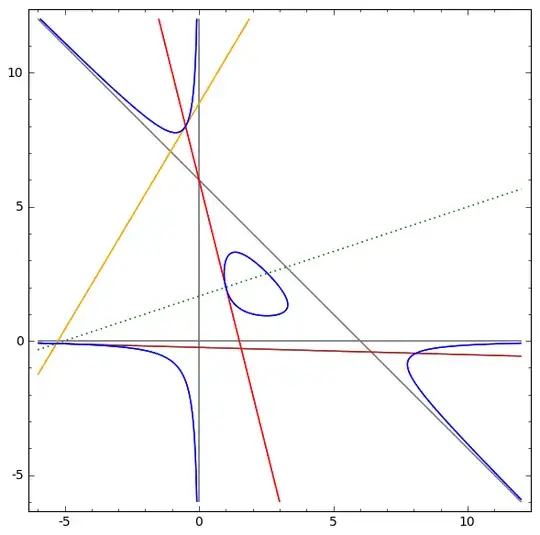
The following Sage plot shows:

in $\color{blue}{\text{blue}}$, the curve $E_{6,6}$, projected to the $(a,b)$ plane (with both coordinates in $[-6,12]$);

in $\color{gray}{\text{gray}}$, the asymptotes $a=0$, $b=0$, and $c=0$;

and in $\color{orange}{\text{orange}}$, $\color{red}{\text{red}}$, and $\color{brown}{\text{brown}}$, the tangents to the curve at $(a_i,b_i,c_i)$ that meet the curve again at $(a_{i+1},b_{i+1},c_{i+1})$, for $i=0,1,2$:

(source: harvard.edu)

Further solutions can be obtained intersecting $E$ with the line joining two non-consecutive points; this illustrated by the dotted $\color{green}{\text{green}}$ line, which connects the $i=0$ to the $i=2$ point, and meets $E$ again in a point $(20449/8023, 25538/10153, 15123/16159)$ with all coordinates positive.

In the modern theory of elliptic curves, the rational points (including any rational "points at infinity", here the asymptotes) form an additive group, with three points adding to zero iff they are the intersection of $E$ with a line (counted with multiplicity). Hence if we denote our initial point $(1,2,3)=(a_0,b_0,c_0)$ by $P$, the map $T$ is multiplication by $-2$ in the group law, so the $i$-th iterate is $(-2)^i P$, and $(20449/8023, 25538/10153, 15123/16159)$ is $-(P+4P) = -5P$. Cyclic permutations of the coordinates is translation by a 3-torsion point (indeed an elliptic curve has a rational 3-torsion point iff it is isomorphic with $E_{S,P}$ for some $S$ and $P$), and switching two coordinates is multiplication by $-1$. The iteration constructed by Tito Piezas III is multiplication by $\pm 3$ in the group law; in general, multiplication by $k$ is a rational function of degree $k^2$.

Glorfindel
  • 4,000
20

We just need to prove that for infinite values of $q\in\mathbb{Q}$ the polynomial $$ p(x)=x^3-6x^2+qx-6 $$ completely splits over $\mathbb{Q}$. That is the same as requiring that $$ p(x+2) = x^3+(q-12)x+(2q-22) $$ completely splits over $\mathbb{Q}$. Assuming that $u,w,w$ are the roots of the above polynomial, then $u+v+w=0$, $uv+uw+vw=(q-12)$, $uvw=22-2q$, so we just need to show that there is an aperiodic rational map $\phi:(u,v)\to(\tilde{u},\tilde{v})$ that preserves: $$-2=uvw+2(uv+uw+vw) = -2u^2-2uv-2v^2-u^2 v- v^2 u$$ but honestly I do not know how to find it without invoking the group structure for an elliptic curve.

Jack D'Aurizio
  • 361,689
  • 2
    You probably shouldn't take it so seriously. It's either someone just downvoting for no reason, or they read the OP's specific request for "no elliptic curves" and didn't like that you had to use them eventually. Also, where does $p(x)$ come from and why does that property suffice? – zibadawa timmy Aug 05 '15 at 00:11
  • 3
    If $p(x)$ is a monic cubic polynomial with roots $x = a,b,c$, then $p(x) = (x-a)(x-b)(x-c)$ $= x^3 - (a+b+c)x^2 + (ab+bc+ca)x - abc$ $= x^3 - 6x^2 + qx - 6$, where $q = ab+bc+ca$ is some rational number. – JimmyK4542 Aug 05 '15 at 00:13
  • Thanks for this, though I am still hoping for an elementary solution, if there is one. –  Aug 05 '15 at 01:10
4

A rational triple $(a,b,c)$ satisfies $a+b+c=abc=6$ if and only if $$c=6-a-b\qquad\text{ and }\qquad ab(6-a-b)=6,$$ where the latter is equivalent to $$a\cdot b^2+a(a-6)\cdot b+6=0,$$ which shows that $b=\tfrac{6-a}{2}\pm\tfrac{1}{2a}\sqrt{a^2(a-6)^2-24a}$. Because $a$ and $b$ are rational, the expression $$a^2(a-6)^2-24a=a^4-12a^3+36a^2-24a,$$ must be a rational square. So it suffices to show that the curve $$x^4-12x^3+36x^2-24x=y^2,$$ has infinitely many rational points. I don't see an elementary way to do so. It may be worth noting that it can be seen to have the rational points $(0,0)$ and $(2,2)$.

A blunt way to finish is to note that this curve is birational to the elliptic curve $$y^2=x^3-9x+9,$$ of positive rank, so indeed there are infinitely many rational solutions.

Servaes
  • 67,306
  • 8
  • 82
  • 171
  • Why can't we finish from what is in here: http://math.stackexchange.com/questions/1388371/quartic-polynomial-taking-infinitely-many-square-rational-values/1388441?noredirect=1#comment2830543_1388441 ? – Sandeep Silwal Aug 09 '15 at 03:37
  • I finish with more or less the same remark @Tito Piezas III makes in the comments to his own answer. From his answer itself it is not clear that there are in fact infinitely many rational points. – Servaes Aug 10 '15 at 12:34
2

The question is about showing simple methods not involving elliptic curves for finding rational solutions of $\,a+b+c=abc=6.\,$

My method uses generalized Somos-4 sequences. Define the integer sequences

$$ u_0 = 0,\, u_1 = 1,\, u_2 = 2,\, u_3 = 105,\,u_4 = 1292,\, u_n = (-1)^n u_{-n},\\ u_n = (-4u_{n-1}u_{n-3} + 105u_{n-2}u_{n-2})/u_{n-4} \quad \text{ for }\quad n>4,\\ x_n = -(-1)^n(u_{n-1} u_n u_{n+2} + 2u_{n-1} u_{n+1}^2 + 19u_n^2 u_{n+1})/2, \\ y_n = -(-1)^n(- u_{n-1} u_n u_{n+2} + u_{n-1} u_{n+1}^2 + 2u_n^2 u_{n+1}), \\ z_n = -(-1)^n(u_{n-1} u_n u_{n+2} + 2u_{n-1} u_{n+1}^2 - 17u_n^2 u_{n+1})/2. $$

Then $ x_n^3 + 2y_n^3 + 3z_n^3 = 6x_n y_n z_n $ for all integer $n$.

This is a small table of values: $$\begin{array}{|c|c|c|c|c|} \hline n & x_n & y_n & z_n & u_n \\ \hline -3 & 282473 & -86392 & -114427 & -105 \\ \hline -2 & 143 & 113 & 71 & 2 \\ \hline -1 & -1 & 2 & -1 & -1 \\ \hline 0 & 1 & 1 & 1 & 0 \\ \hline 1 & 19 & 4 & -17 & 1 \\ \hline 2 & 16307 & -9281 & -8747 & 2 \\ \hline 3 & 259124723 & -209103562 & 2727323 & 105 \\ \hline \end{array}$$

Based on the MSE question 1388136 with a sign change for $z_n,$ if we define

$$ a_n := \frac{3z_n^2}{x_n y_n},\;\; b_n := \frac{x_n^2}{y_n z_n}, \;\; c_n := \frac{2y_n^2}{x_n z_n}, $$

then $(a_n,b_n,c_n)$ are a sequence of rational solutions to $\,a+b+c=abc=6.$

This is a small table of values: $$\begin{array}{|c|c|c|c|} \hline n & a_n & b_n & c_n \\ \hline -2 & \frac{15123}{16159} & \frac{20449}{8023} & \frac{25538}{10153} \\ \hline -1 & -\frac32 & \frac12 & 8 \\ \hline 0 & 3 & 1 & 2 \\ \hline 1 & \frac{867}{76} & -\frac{361}{68} & -\frac{32}{323} \\ \hline 2 & \frac{229530027}{151345267} & \frac{265918249}{81180907} & \frac{172273922}{142637329} \\ \hline \end{array}$$

This does not produce all solutions. For example, $\,(\frac{25}{21},\frac{54}{35},\frac{49}{15})\,$ is a solution.

The question asks for infinitely many rational triple solutions $\,(a,b,c)\,$ but does the sequence satisfy this? I am not sure how the distinctness of the solutions can be rigorously proven without involving the theory of elliptic curves or some kind of equivalent theory.

Somos
  • 37,457
  • 3
  • 35
  • 85