Assume the following is in in $\mathbb{R}^n$
1. If $d_i,d_j$ are orthogonal with $i \neq j$, it means $d_i^Td_j=0$.
2. If $d_i,d_j$ are $A$-orthogonal with $i \neq j$, it means $d_i^TAd_j=0$.
In many lecture, it can be viewed as the following:
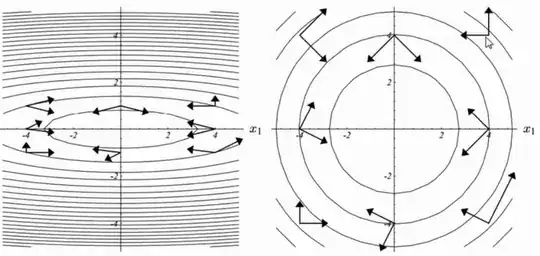
The left is $A$-orthogonal, the right is orthogonal. Why?
It seems this is related to the rotation and decomposition of a matrix. However I am weak in this part. Could anyone give me a clear explanation of it?

