I'm reading Hartshorne AG V.3 on monoidal transformations and embedded resolutions. I understand one sort of intuition behind blowing up a point on a surface (or more generally a subvariety of a nonsingular variety), which is that you replace the point with the projective space of normal directions to the point. With this in mind, it is clear that two curves meeting transversally at a point in a surface $X$ separate in the blowup of $X$ along the point of intersection.
A case that I do not have a good feel for is the cusp ($y^2=x^3$ in the plane).
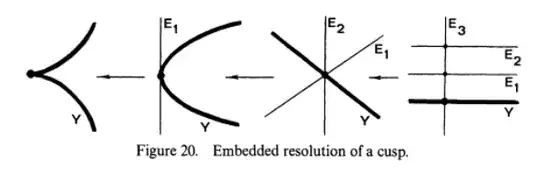
It's not hard to write down equations in this case. However, what I would like to know is if there is any good geometric rationale that one can "tell just by looking" that blowing up the cusp gives a strict transform which is tangent to the exceptional divisor at a point? Considering only the first monoidal transformation above, why might it be obvious that the strict transform does not cross the exceptional divisor transversely?


