26

Some older complex analysis textbooks state that $ \displaystyle \int_{0}^{\infty}e^{-x^{2}} \ dx$ can't be evaluated using contour integration.

But that's now known not to be true, which makes me wonder if you can ever definitively state that a particular real definite integral can't be evaluated using contour integration.

Edit: (t.b.) a famous instance of the above claim is in Watson, Complex Integration and Cauchy's theorem (1914), page 79:
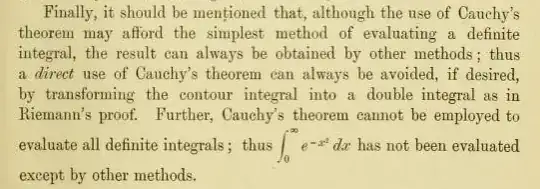
Watson's claim

  • 1
    Could you add references for your statements? E.g., which older complex analysis textbooks do state this where? –  Mar 31 '12 at 19:29
  • 2
    @Thomas: see edit. – t.b. Mar 31 '12 at 20:02
  • 5
    How about considering an integral on the real line that is so bizarre that it cannot be a profile of some holomorphic function? – Sangchul Lee Mar 31 '12 at 22:55
  • @sos440 Would you give an example? I'd vote for that answer. Would something like $\int_{\mathbb{R}}e^{-1/x^2}\cdot e^{-x^2},dx$ work? – 2'5 9'2 Apr 05 '12 at 03:46
  • $\int_0^1|\sin(1/x)|dx$? – AD - Stop Putin - Apr 11 '12 at 09:28
  • 3
    While I find this question very interesting, I have to note that the formulation in the quoted text is quite prudent. It does circumvent the statement that the example cannot be evaluated. – Phira Apr 26 '12 at 13:36
  • Huh, how do we compute $\int_0^1 x^2 dx$ with contour integration? – Yrogirg May 11 '12 at 06:25
  • 1
    @Yrogirg: (late answer...) quite simply by taking as contour the first quarter of the circle : $\displaystyle \int_0^1 x^2,dx+\int_0^{\frac {\pi}2} e^{2i\phi}ie^{i\phi},d\phi +\int_1^0 (ix)^2 i,dx=0\ $ that becomes $\ \displaystyle (1+i)\int_0^1 x^2,dx=\frac {1+i}3 $. – Raymond Manzoni Jul 06 '12 at 08:36
  • @RaymondManzoni You can answer http://math.stackexchange.com/questions/156372/is-it-possible-to-evaluate-int-01-xn-dx-by-contour-integration – Yrogirg Jul 06 '12 at 10:40
  • @Yrogirg: I did just that (I had to change a bit the principle of the fixed angle $\frac {\pi}2$ to avoid the problems for odd $n$). I hope you'll like it! – Raymond Manzoni Jul 06 '12 at 13:18

1 Answers1

4

There are such functions. For example, anything with infinitely many discontinuities. Take the Dirichlet function as an example; it is Lebesgue integrable, but one could not integrate it using the method of residues, which requires that there are only finitely many poles of the function on the real line.

rotskoff
  • 276