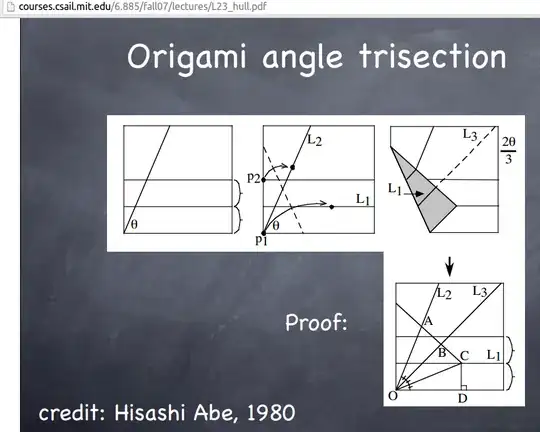
I'll only go up to describing the fold. Let the paper be a unit square. Let $L_1$ be a horizontal line at height $h$,
$$
L_1: y=h
$$
Then $P_2$ is $(0,2h)$. We name our fold $F_1$, with the ends on $(a,0)$ at the bottom side and $(0,b)$ on the left side (let's assume $a,b > 0$ for now).
$$
F_1: y=b-{b\over a}x
$$
As we fold, the point $P_1$ on origin $(0,0)$ will be reflected onto point $P'_1$. As it is a reflection, the line connecting $P_1$ and $P'_1$ should be perpendicular to the fold, and the midpoint should lie on the fold. This line is
$$
y = {a\over b}x
$$
We require $P'_1$ to lie on $L_1$, thus
$$
h={a\over b}x
$$
therefore $P'_1=({b\over a}h, h)$. Plugging in the midpoint $({b\over 2a}h,{1\over 2}h)$ into $F_1$, we get our first constraint
$$
{1\over 2}h=b-{b\over a}\left({b\over 2a} h\right) \\
\therefore a = b\sqrt{h \over h-2b}
$$
Let's plug this into $F_1$
$$
F_1: y=b-\sqrt{h-2b\over h}x
$$
Next, we have line $L_2$ with a slope $k=\tan \theta$
$$
L_2: y=kx
$$
We apply the same argument for reflecting $P_2$ onto $P'_2$. It should lie on the line perpendicular to the fold and passing $P_2$
$$
y=2h+{a\over b}x=2h+\sqrt{h\over h-2b}x
$$
while at the same time also lying on $L_2$, thus
$$
kx = 2h+{a\over b}x=2h+\sqrt{h\over h-2b}x \\
\therefore P'_2 = \left({2h \over k - \sqrt{h\over h-2b}},{2kh \over k - \sqrt{h\over h-2b}}\right)
$$
Then, the midpoint
$$
\left({h \over k - \sqrt{h\over h-2b}},h\left(1+{k \over k - \sqrt{h\over h-2b}}\right)\right)
$$
should lie on $F_1$
$$
h\left(1+{k \over k - \sqrt{h\over h-2b}}\right) = b - \sqrt{h-2b\over h}\left({h \over k - \sqrt{h\over h-2b}}\right)
$$
This determines the value of $b$. Good luck with finding $b$!
When I first saw the intriguing claim that the origami axiom can be used to solve cubic equations, I was filled with excitement. Maybe once and for all I could finally do away with Cardano's or Viete's formulas and have an elegant way of solving. Alas, it is at this very last equation above that I realise that the theorem only looks nice on paper. Finding the fold itself requires you to solve a cubic equation, bringing you back to square one.