31

For any $n\geq 0$, the unit $n$-sphere is the space $S^{n}\subset \mathbb{R}^{n+1}$ defined by $$ S^{n}=S^{n}(1) := \left\{ (x_{1}, \dots, x_{n+1}) \;\middle\vert\; \sum_{i=1}^{n+1} x_{i}^{2} = 1 \right\} $$ with the subspace topology. The point $P = (0, \dots, 0, 1)$ in $S^{n}$ called the north pole. Then we have the following conclusion:

$\qquad\qquad\qquad$ For any $n\geq 0$, $S^{n}$ with the north pole removed is homeomorphic to $\mathbb{R}^{n}$.


$\qquad\qquad\qquad\qquad\qquad$FIGURE 1-1
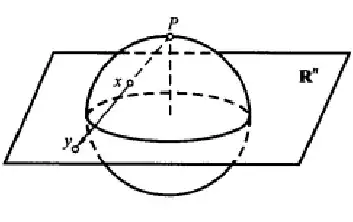
From FIGURE 1-1 ,we define a map $$ f: S^{n} \setminus \{P\} \to \mathbb{R}^{n}, \quad x \mapsto \frac{1}{1-x_{n+1}} \cdot (x_1, \cdots , x_n). $$

(This map is called stereographic projection.)

It can be described geometrically as follows: Given a point $x = (x_{1}, \dots, x_{n+1}) \in S^{n} \setminus \{P\}$, stereographic projection sets $f(x) = y$, where $(y, 0)$ is the point where the line through $P$ and $x$ meets the subspace $\mathbb{R}^{n} \times \{0\}$ at $u = (y,0) = (y_{1}, \dots, y_{n}, y_{n+1})$.

Hence,
$$ \left\{\begin{matrix} u = \lambda x+(1-\lambda )P \\ y_{n+1} = 0 \end{matrix}\right. \quad(\lambda \in\mathbb{R}) \Longrightarrow \lambda = \frac{1}{1-{x}_{n+1}}. $$ So the analytical expression of the stereographic projection is $$ f(x_{1}, \dots, x_{n+1}) = \left( \frac{x_{1}}{1-{x}_{n+1}}, \dots, \frac{x_{n}}{1-{x}_{n+1}} \right) \in \mathbb{R}^{n}. $$


From the geometric intuition,we can get the map $f: S^{n} \setminus \{P\} \to \mathbb{R}^{n}$ is bijective, but how can I prove it theoretically. Further, I need some rigorous proofs that $f: S^{n} \setminus \{P\} \to \mathbb{R}^{n}$ is a homeomorphism. (We must strictly demonstrate that $f$ is injective, surjective, and continuous.)

Another question:

I know the analytical expression of the inverse $f^{-1}: \mathbb{R}^{n} \to S^{n} \setminus \{P\}$ is $$ f^{-1} (y_1, \dots, y_n) = \frac{1}{\|y\|^2 + 1}(2y_1, \dots, 2y_n, \|y\|^2 - 1), \quad \text{where } \|y\|^2 = y_1^2 + \dots + y_n^2. $$ But how can I get this expression?

Who can provide some related materials or solutions about these? (I want use some knowledge of Differential Calculus in Several Variables to solve these questions). Any of your help will be appreciated!

Sammy Black
  • 28,409
  • I think using topological language will be useful and give a cleaner proof than epsilon-delta language in showing the continuity. By considering the composition of f and the projection maps, we can show the continuity clearly. After all, when we are talking about homeomorphisms, we are dealing with topological properties. – Oscar LIU Apr 26 '17 at 10:44

4 Answers4

11

Hint: To show that $f$ is bijective, one can often (as can be managed here) compute $f^{-1}$ explicitly. Then, to show that $f$ is a homeomorphism, by definition it remains to show that $f$ and $f^{-1}$ are continuous, but they are both visibly compositions of continuous functions.

Travis Willse
  • 108,056
  • Is $S^n \setminus {p}$ a compact space? I think it isn't because $S^n$ is closed and removing a point from it no longer makes it a closed space. – null May 06 '18 at 04:29
  • It is noncompact for $n > 0$ (but notice that for $n = 0$ it is compact, so the reasoning you give cannot hold in general). – Travis Willse May 06 '18 at 16:01
  • Right, for $n=0$ , it is just $x^2 = 1$ that is two points +1, -1. I don't want to say $S^n \setminus {p}$ is not compact as is it is homeomorphic to $R^n$ which is non-compact. I think going back to the basic definition of compactness, around ${p} = (0,0,...1)$ open cover generated by open balls on $S^n \setminus {p}$ with fixed n-th co-ordinate $x_n = (1- \dfrac{1}{n}) \ \ \forall n$ have no finite subcover, hence it is non-compact. Please tell me if I make sense. – null May 07 '18 at 04:39
  • That's correct, but I'm not sure why you're concerned with compactness in this situation. – Travis Willse May 07 '18 at 10:06
  • Nothing particularly, I just wanted to be sure. Thanks for commenting. – null May 08 '18 at 02:12
7

Alternatively, stereographic projection maps circles to circles, and so for topological reasons $f$ maps open disks in the planes into open discs on $S^n - \{p\}$ (regions with circular boundary). But the set of open disks in the plane is a basis for the standard topology on the plane, and hence (once you know it exists) $f^{-1}$ is continuous. Similarly, so is $f$.

Travis Willse
  • 108,056
  • I want use some knowledge of Differential Calculus in Several Variables to solve these questions.eg:the implicit function theorem. –  Jan 28 '15 at 13:53
2

Let $x=(x_1,\ldots,x_n,x_{n+1})$ be the point in the sphere whose projection on the plane is $y = (y_1,\ldots,y_n)$. As you said before, the relation between the coordinates of those points is: \begin{equation} y_i = \frac{x_i}{1-x_{n+1}} \quad \forall i \in \{ 1,\ldots, n \}, \end{equation} with $y_{n+1} = 0$. We want to find the inverse of the projection, $f^{-1}: \mathbb{R}^n \longrightarrow \mathbb{S}^n-\{p\}$, i.e. we want to find $x_i$ as a function of $y_i$, given $y_i$. But the above relation only gives us $n$ equations and we have $n+1$ unknowns. To find one more equation, we can do some reverse-engineering. For $f^{-1}$ to be well defined, it is necessary that the output be a point of the sphere. This gives us the extra equation we needed: $$ x_1^2 + \ldots + x_n^2 + x_{n+1}^2 = 1.$$ Plugging in the above relations: $$ 1 = (1-x_{n+1})^2(y_1^2+\ldots + y_n^2) + x_{n+1}^2 = (1-x_{n+1})^2||y||^2 + x_{n+1}^2.$$ Equivalently, this is a second order equation with $x_{n+1}$ being the only unknown: $$ (1-||y||^2)x_{n+1}^2 -2||y||^2x_{n+1} + (||y||^2-1) = 0.$$ If you apply the classical formula to solve this equation, you either get $x_{n+1} = 1$ or $x_{n+1} = 1 - 2/(1+||y||^2)$. Since we know that $x_{n+1}$ must satisfy the initial relations, it is obvious that the first solution must be discarded, so $x_{n+1} = 1 - 2/(1+||y||^2)$. Plugging this in the initial equations, we get: $$ x_i = \frac{2y_i}{1+||y||^2} \quad \forall i \in \{ 1,\ldots, n \},$$ $$ x_{n+1} = 1 - \frac{2}{1+||y||^2} = \frac{||y||^2-1}{1+||y||^2}. $$

Rainbow
  • 181
1

You are asking two questions in your post: i) How to prove that $f\circ f^{-1} = f^{-1}\circ f = \text{Id}$ and bicontinuity, ii) how to obtain the expression for the inverse?

ii) I myself tried to do this geometrically, but at least I haven't managed to do so. My best guess would be: Take $n = 2$ or $n = 3$, do it analytically there and then generalize to an arbitrary number of dimensions. Once you have it, you can explicitly show i). Or maybe one can even take the general definition of the stereographic projection and invert it in general...

i) Concerning the bicontinuity, I refer to this post and the already given answers.

  • Let's first prove that $f(f^{-1}(x)) = x$, where $x \in \mathbb R^{n}$. This one is straightforward: $$ f(f^{-1}(x)) = f\left( \left( \frac{2x_1}{1+||x||_2^2}, \dots, \frac{2x_n}{1+||x||_2^2}, 1-\frac{2}{1+||x||_2^2} \right)^T \right) = \dots = x.$$ Again, this one is straightforward, just use the stereographic map $f$.

  • Now let's prove that $f^{-1}(f(x))$, where $x\in S^n\backslash\{p\}\subset\mathbb R^{n+1}$: $$f^{-1}(f(x)) = f^{-1}\left(\frac{1}{1-x_{n+1}} \begin{pmatrix}x_1, \dots, x_n\end{pmatrix}^T \right)$$

I will prove $f^{-1}\left( \frac{1}{1-x_{n+1}}\begin{pmatrix}x_1, \dots, x_n\end{pmatrix}^T\right) = x$ by proving $f^{-1}(\dots)_i = x_i$, where I denote by $f^{-1}(\dots)_i$ the $i$-th component of $f^{-1}(\dots)$ for $i\in \{1, \dots, n-1\}$, and by separately proving $f^{-1}(\dots)_n = x_n$. I do this because of the way that $f^{-1}$ is given: The last component of the input is transformed differently than the other components.

So, let's start with $f^{-1}(f(x))_i$: $$f^{-1}(f(x))_i = \frac{2x_i}{1-x_{n+1}}\cdot \frac{1}{1+\lvert\lvert \frac{1}{1-x_{n+1}}\begin{pmatrix}x_1, \dots, x_{n+1}\end{pmatrix}^T \rvert\rvert_2^2} = \frac{2x_i}{1-x_{n+1}+\frac{1}{1-x_{n+1}}\sum_{j=1}^{n}x_j^2}.$$ We can now use two facts: Firstly, $\lvert\lvert x \rvert\rvert_2^2 = \sum_{j=1}^{n}x_j^2 + x_{n+1}^2$, since $x\in S^n\backslash \{p\}\subset \mathbb R^{n+1}$. Secondly, $\lvert\lvert x \rvert\rvert_2^2 = 1$, by definition of the unit ball. Thus, we can rewrite $\sum_{j=1}^{n}x_j^2 = 1-x_{n+1}^2$: $$ f^{-1}(f(x))_i = \frac{2x_i}{1-x_{n+1}+\frac{1-x_{n+1}^2}{1-x_{n+1}}} = \dots = x_i,$$ which is now easy to show. Similarly, we can show that $f^{-1}(f(x))_n = x_n$. $\blacksquare$

Hermi
  • 1,021