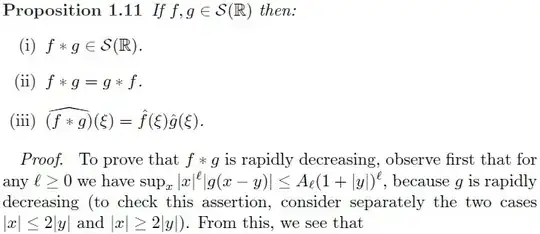
For the proposition (i), I don't know how to show the inequality in the second line of the proof, can someone help me?
For the proposition (i), I don't know how to show the inequality in the second line of the proof, can someone help me?


Notice that $$\sup_x|x|^l\cdot|g(x-y)|=\sup_t|t+y|^l\cdot|g(t)|.$$ Since $$\sup_{|t|\leqslant |y|}|t+y|^l\cdot|g(t)|\leqslant 2^l|y|^l\sup_{t}|g(t)|$$ and $$\sup_{|t|\gt |y|}|t+y|^l\cdot|g(t)|\leqslant 2^l\sup_{t}|t|^l|g(t)|,$$ we have $$\sup_t|t+y|^l\cdot|g(t)|\leqslant 2^l(1+|y|^l)\max\left\{\sup_{t}|g(t)|,\sup_{t}|t|^l|g(t)|\right\}.$$
I want to add some more details to Davide's nice answer $\color{red}{\text{in red}}$. (The first time I read that answer, it took me some time to digest all that it was saying, since I think that there was a "gap" between where I was at when I had finished my first course in real analysis and the level that the answer was written at, and I wrote down Davide's answer in the level of detail I was comfortable with at the time. So I hope this "answer" or "supplement" of mine helps others who read Davide's answer and found it helpful, but may benefit from seeing things written out at greater length.)
Fix $y\in\mathbb R$.
$\color{red}{\text{Notice that}}$ $$\color{red}{\sup_{x}|x|^l\cdot|g(x-y)|=\sup_{t}|t+y|^l\cdot|g(t)|.}$$ This is true because the sets of numbers $\{|x|^l\cdot|g(x-y)|:x\in\mathbb R\}$ and $\{|t+y|^l\cdot|g(t)|:t\in\mathbb R\}$ are equal: for every element in the right hand set, we can find it in the left hand set, and vice-versa.
$\color{red}{\text{Since}}$ $$\color{red}{\sup_{|t|\leqslant |y|}|t+y|^l\cdot|g(t)|\leqslant 2^l|y|^l\sup_{t}|g(t)|}$$ Remember that $y$ is fixed. The left hand side $\sup_{|t|\leqslant |y|}|t+y|^l\cdot|g(t)|$ is the same as $\sup_{|t|\leqslant |y|}|t+y|^l\cdot\sup_{|t|\leqslant |y|}|g(t)|$ since everything is non-negative. We can estimate $\sup_{|t|\leqslant |y|}|g(t)|\leqslant \sup_{t\in\mathbb R}|g(t)|$ since the right hand sup is taken over a larger set. By the triangle inequality, $|t+y|\le |t| + |y|$, and since $l\ge 0$, the inequality $|t+y|^l\le (|t| + |y|)^l$ holds. Since we are taking the first sup over all $t$ satisfying $|t|\leqslant|y|$, we have the estimate $\sup_{|t|\leqslant|y|}(|t| + |y|)^l\leqslant\sup_{|t|\leqslant|y|}(2|y|)^l = 2^l|y|^l$ since this last expression doesn't depend on $t$. Putting this together gives the claimed estimate.
$\color{red}{\text{and}}$ $$\color{red}{\sup_{|t|\gt |y|}|t+y|^l\cdot|g(t)|\leqslant 2^l\sup_{t}|t|^l|g(t)|,}$$ This is similar to the last inequality. This time, as the sup is taken over all $t>y$, we have the estimate $|t+y|^l\leqslant |2t|^l=2^l|t|^l$ for every $t$. Thus we have the intermediate estimate $\sup_{|t|\gt |y|}|t+y|^l\cdot|g(t)|\leqslant 2^l\sup_{|t|>|y|}|t|^l|g(t)|$. Now, this latter expression is $\leqslant 2^l\sup_{t}|t|^l|g(t)|$, since this sup is taken over a larger set (all of $\mathbb R$). This gives us the claimed estimate.
$\color{red}{\text{we have}}$ $$\color{red}{\sup_t|t+y|^l\cdot|g(t)|\leqslant 2^l(1+|y|^l)\max\left\{\sup_{t}|g(t)|,\sup_{t}|t|^l|g(t)|\right\}.}$$ Since everything is non-negative, we can break up the left hand sup as $$ \sup_t|t+y|^l\cdot|g(t)| \leqslant \sup_{|t|\leqslant |y|}|t+y|^l\cdot|g(t)|+\sup_{|t|\gt |y|}|t+y|^l\cdot|g(t)|. $$ Using our previous two estimates, we have $$ \sup_{|t|\leqslant |y|}|t+y|^l\cdot|g(t)|+\sup_{|t|\gt |y|}|t+y|^l\cdot|g(t)|\leqslant 2^l|y|^l\sup_{t}|g(t)|+2^l\sup_{t}|t|^l|g(t)|. $$ Now replace both $\sup_{t}|g(t)|$ and $\sup_{t}|t|^l|g(t)|$ by their maximum and factor it out to get the final claimed inequality: $$ 2^l|y|^l\sup_{t}|g(t)|+2^l\sup_{t}|t|^l|g(t)| \leqslant 2^l(1+|y|^l)\max\left\{\sup_{t}|g(t)|,\sup_{t}|t|^l|g(t)|\right\}. $$

Consider the hints from the authors:
When $\left\vert x \right\vert \leq 2\left\vert y \right\vert$, then \begin{equation*} \left\vert x \right\vert^\ell\left\vert g(x-y) \right\vert\leq C_0\left\vert 2y \right\vert^\ell\leq2^\ell C_0 (1+\left\vert y \right\vert)^\ell, \end{equation*} where $C_0\geq \sup\left\vert g(x-y) \right\vert$.
When $\left\vert x \right\vert > 2\left\vert y \right\vert$, then \begin{align*} \left\vert x \right\vert^\ell\left\vert g(x-y) \right\vert &= \left\vert (x-y) + y \right\vert^\ell\left\vert g(x-y) \right\vert\\ &=\left\vert (x-y) \right\vert^\ell \left\vert 1 + \frac{\left\vert y \right\vert}{\left\vert x-y \right\vert} \right\vert^\ell\left\vert g(x-y) \right\vert\\ &\leq\left\vert (x-y) \right\vert^\ell \left\vert 1 + \frac{\left\vert y \right\vert}{\left\vert x \right\vert - \left\vert y \right\vert} \right\vert^\ell\left\vert g(x-y) \right\vert\\ &\leq\left\vert (x-y) \right\vert^\ell \left\vert 1 + \frac{\left\vert y \right\vert}{\left\vert 2y \right\vert - \left\vert y \right\vert} \right\vert^\ell\left\vert g(x-y) \right\vert\\ &=\left\vert (x-y) \right\vert^\ell 2^\ell\left\vert g(x-y) \right\vert\\ &\leq 2^\ell\left\vert (x-y) \right\vert^\ell C_{\ell}\left\vert x-y \right\vert^{-\ell}\\ &\leq 2^\ell C_{\ell}(1+\left\vert y\right\vert)^{\ell}, \end{align*} where $C_\ell\geq \sup \left\vert (x-y) \right\vert^\ell\left\vert g(x-y) \right\vert$.
Now let $A_\ell = 2^\ell\max\{C_0, C_\ell\}$.
