I think you've misunderstood what the parity data is. They're not parity checks, so it's not true that "each parity block is specific to each disc it belongs to." The parity data is to allow recovery from a failed disc.
Let's go back to RAID-4 for a second, and assume we have three discs: discs $0$ and $1$ are data and disc $2$ is parity. "Parity" means that the $b$th block of disc $2$ is the xor of the $b$th blocks of discs $0$ and $1$. The point is that, if any single disc fails, we can recover its data because the $b$th block of any disc is the xor of the $b$th block on the other two discs. For this to work, it's crucial that the parity data is on a separate discs. If you only had two discs and put the parity data on those discs (e.g., each disc was two-thirds data blocks and one-third parity blocks) then the failure of a single drive would destroy some blocks and their corresponding parity data, so you'd be unable to recover the data using just what was left on the remaining disc.
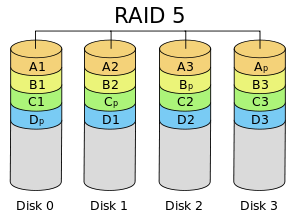
RAID-5 is the same idea except that, instead of putting all the parity data on the last disc, it's spread across all the discs. So, for a three-disc set-up, a third of the blocks would have parity data on disc $2$, a third on disc $1$ and a third on disc $0$.
The point of using RAID-5 rather than RAID-4 is that every time you write data, the corresponding parity block must be updated. If all parity data is on the same disc, that disc will be written to much more than the other discs ($k$ times as much, in a $k$-disc sytem), so it will fail faster. Spreading the parity data across the discs evens out the wear on them.