The diameter of an undirected, unweighted graph can be found in $O(n^3)$ with e.g. the Floyd–Warshall algorithm. However, there is an idea how to improve the runtime:
- Pick a vertex $v$
- Find $u$ such that $d(v,u)$ is maximum
- Find $w$ such that $d(u,w)$ is maximum
- Return $d(u,w)$
This idea fails; for instance, when starting at $v$ here:
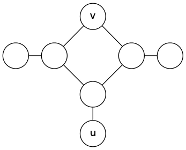
However, it is not immediately clear to me if we can not amend the above algorithm with another indirection, and also consider all nodes with maximum distance instead of only one. That is:
- Pick a vertex $v$
- Find the set $U$ such that $u \in U \implies d(v,u)$ is maximum
- For each node $u$ in $U$, find the set $W_u$ such that $w \in W \implies d(u,w)$ is maximum
- Merge these sets $W_u$ into a new set $W$
- Calculate the eccentricity of all nodes in $W$
- Return the maximum eccentricity found this way
The improved algorithm works for the above counterexample as well as others (e.g. this one).
I assume it is still wrong. If it were not, it would offer a significant improvement for at least some kinds of graphs. Is there a counterexample? And how could a counterexample for further additional indirections be constructed?


