Given the following definition of a psuedorandom generator, I'm having trouble understanding what exactly the "distinguisher" D is outputting, and when?
Given the following definition of a psuedorandom generator, I'm having trouble understanding what exactly the "distinguisher" D is outputting, and when?

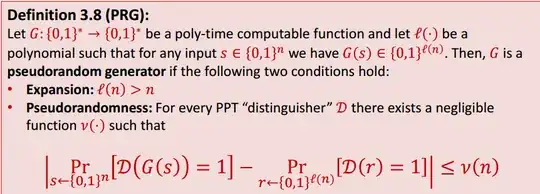
$D$ outputs a bit $b \in \lbrace 0,1 \rbrace$. When $b = 0$, it means that $D$ is guessing that the string it has been given was drawn uniformily at random from $\lbrace 0 , 1 \rbrace^{\ell(n)}$, while when $b = 1$, it means that $D$ believes the string it has been given was produced by the PRG $G$ (or vice versa).

As said before, the distinguisher D outputs a bit.
I would like to add that the advantage is a measurement for how good the distinguisher is doing. Say you have two distributions which are computationally indistinguishable, then $adv_D$ is negligigle close to 0. On the other hand, if the two distributions are easy to distinguish, then $adv_D$ would be close to 1.
On your formula, the advantage of D is: $$adv_D = |Pr(D(X)=1) - Pr(D(Y)=1)|$$.
If the distributions are indistinguishable, a distinguisher cannot succeed on doing its job, i.e. distinguishing the two distributions. Then, the output of D is the same regardless of having distribution X or distribution Y as input.
If you need further reading I strongly recommend you having a look at the paper "On the Role of Definitions in and Beyond Cryptography", by Rogaway. There he explains clearly the concept of distinguisher.
