0

I'm seriously considering purchasing an Ender 3 Max Neo, but I'm unsure if I'll be able to fit it on my desk (i.e. I'm not sure if my desk is deep enough)

The specs report the machine dimensions as being 516 mm x 582 mm x 590 mm. When I look at pictures of the unit it appears the rod for the Y rail protrudes past the front of the main unit, so I'm hoping I can get away with a table that is less than 582 mm deep.

Does anyone know how deep a table I will need to support this unit, assuming the table is hard up against a wall?

agarza
  • 1,734
  • 2
  • 16
  • 33
davidgo
  • 109
  • 4

2 Answers2

1

It is hard to find some measurements on the Ender 3 Max Neo to help you out, but, with the help of question How to calculate linear Y rod length for a larger replacement bed? and some videos on the Ender 3 Max Neo we should be able to come up with the space needed in the back and front.

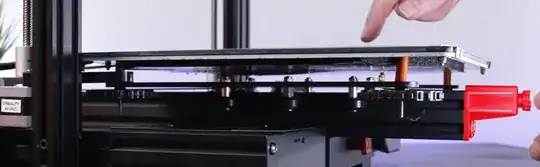
The Y-axis carriage has 6 V-slot rollers running on a 4040 aluminum extrusion profile:
enter image description here

When you know the pitch between the rollers (you need the distance between the first and the last roller) and the diameter of the wheels, you will be able to calculate the overhang of heated bed. Since I have no access to this printer I cannot measure this, but we can make some engineering "guestimations".

enter image description here

From the image above you can deduce that about one third of the bed "overhangs" (beware of the perspective!).
enter image description here

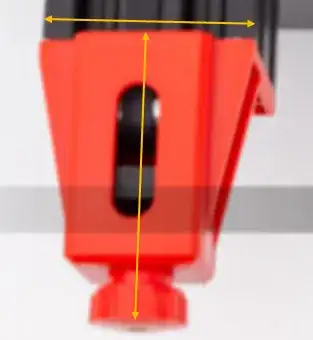
Similarly, you can calculate the length of the Y-axis tensioner to be about 55 mm extending in front of the 4040 extrusion; this implies the bed extends about 80 mm in front of the tensioner.

enter image description here

The back has a NEMA 17 stepper of 42 mm, so an overhang of 90 mm.

This implies that the table should at least be 582 mm + 80 mm + 90 mm = 752 mm deep to fit the bed within the table dimension. At the back you need some space for the bed to reach the home position (when the table has a wall behind it), but you can have the printer extending the bed at the front over the table.

0scar
  • 37,708
  • 12
  • 68
  • 156
1

let'S make some assumptions:

  • The bed is 320x320 mm with a 300x300 square in the center
  • The gantry is a 20 mm profile.
  • the gantry is at the center of the machine.
  • The base is roundabout 582 mm long (with a little leeway to the back due to cable)

Printer side view with measurements of the movement. Green: projected nozzle position.

The swing of the machine is 300 mm from its front positio to the back position during printing. With the 10 mm overhang around the print area that makes for a swing of 620 mm around the center - more than the printer is long. BUT how much does it go to the back?

Taking a photo of the machine, assuming the base frame from red tightener knob to back of the motor to be 582 mm calibrated length, this shows that the bed indeed is about 320 mm large (the error is on the scale of a single pixel). As such, we take the nozzle position and project to the bed, move back 300 mm for the swing, then 10 mm more for the bed edge, and end ca 17 mm behind the motor.

However, we neglected something: The actual stand of the printer stops considerably behind the front edge. Taking a footprint that is 20 mm to the wall behind the bed for extra movement space and 20 cm in front of the front base, the absolute minimum is ca 470 mm depth, with the printer protruding roughly 170 mm from its seat. If protruding from the shelf is no problem and the printer is affixed to its seat somehow, that could be an option for placement.

Same sketch, but with wall and base measured out.

Trish
  • 22,760
  • 13
  • 53
  • 106